

Romantic English
The Theatre of Birds Tapestry Reproduction — A Magnificent Flemish Renaissance Grotesques Masterpiece After Joost van Herzeele RE196681
The Theatre of Birds Tapestry Reproduction — A Magnificent Flemish Renaissance Grotesques Masterpiece After Joost van Herzeele RE196681
Couldn't load pickup availability
The Theatre of Birds Grotesques Tapestry Reproduction — A Magnificent Flemish Renaissance Masterpiece After the Workshop of Joost van Herzeele, Circa 1580
There are tapestries that depict a landscape.
There are tapestries that record a story.
And then there are tapestries such as this—works so exuberant, so richly populated, and so gloriously theatrical that the eye scarcely knows where to begin.
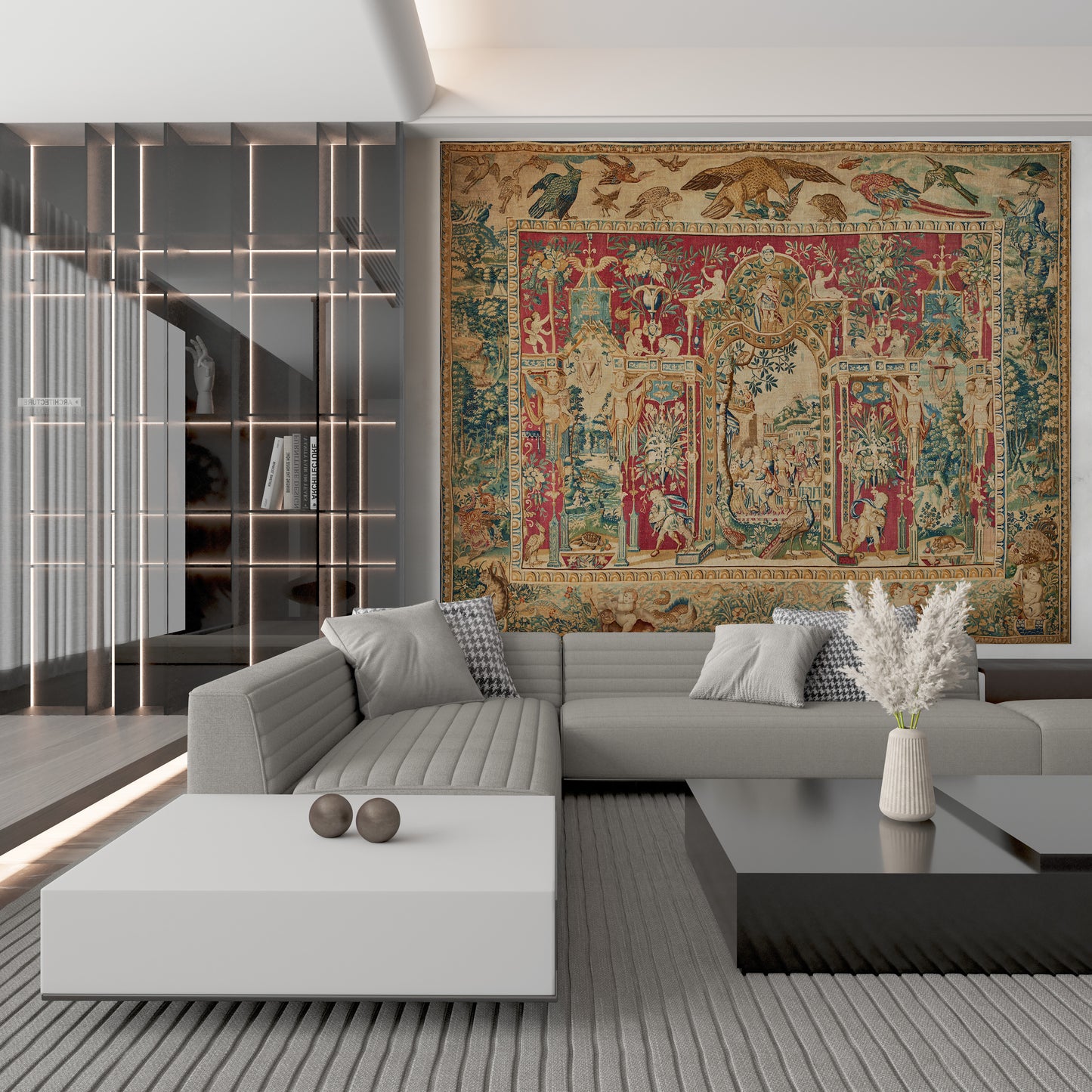
The Theatre of Birds Grotesques Tapestry Reproduction is inspired by an impressive late-sixteenth-century Flemish tapestry attributed to the workshop of Joost van Herzeele, active circa 1575–1590. Originally created in Antwerp during the brilliant final decades of the Renaissance, the design is an extraordinary celebration of ornament, architecture, mythology, nature, and human imagination.
It is not an original antique tapestry.
It is a newly made reproduction of a historic Flemish design—created for modern collectors who wish to live with the splendour of Renaissance decorative art without the rarity, fragility, or formidable cost of acq(Christie's)g sixteenth-century textile.
And what splendour it is.
Across the composition, birds sweep through the upper register like actors arriving upon a celestial stage. Eagles, parrots, cranes, and smaller species gather in animated procession. Below them, (Christie's)itectural fantasy unfolds in crimson, turquoise, gold, ivory, and deep botanical green.
Columns rise.
Arches open.
Figures pose.
Animals wander.
Garlands spill from urns.
Monkeys, beasts, birds, and mythological forms inhabit the borders.
Every inch appears determined to reward attention.
This is not merely wall decoration.
It is an entire Renaissance world.
A Masterpiece of Flemish Grotesque Design
The word grotesque may sound rather severe to the modern ear, but in Renaissance art it described something wonderfully imaginative.
Grotesque ornament brought together human figures, animals, birds, masks, garlands, architectural fragments, plants, mythical creatures, and fanciful decorative forms into elaborate compositions inspired by the rediscovery of ancient Roman wall painting.
The result was playful, learned, and magnificently inventive.
In this tapestry, architecture and nature seem to merge.
Columns are decorated with foliage.
Figures become part of the ornament.
Birds crown the composition like heraldic emblems.
Animals gather within the borders.
The landscape opens behind formal structures, creating a marvellous tension between order and wilderness.
Nothing is merely functional.
Every element has been transformed into theatre.
This was Renaissance decoration at its most confident: intelligent enough to reference antiquity, imaginative enough to reinvent it, and extravagant enough to ensure that no wall could ever again be accused of lacking ambition.
Originally Conceived in Antwerp, Circa 1580
The historic tapestry upon which this reproduction is based is attributed to the workshop of Joost van Herzeele, one of the notable Flemish tapestry makers active during the late sixteenth century.
Van Herzeele worked during a period when the tapestry workshops of the Low Countries were among the most celebrated in Europe. Their productions were commissioned for palaces, noble residences, civic interiors, and the households of wealthy patrons who understood that a great tapestry did far more than cover a wall.
It proclaimed learning.
Taste.
Wealth.
Worldliness.
And, perhaps most importantly, imagination.
Antwerp at this time was a major centre of international trade and artistic exchange. Luxury materials, printed designs, classical ideas, exotic animals, and visual influences from across Europe and beyond flowed through the city.
That cosmopolitan energy is visible throughout this composition.
The birds suggest distant lands.
The architecture recalls antiquity.
The vegetation is abundant and idealised.
The human figures occupy a world somewhere between ceremony and fantasy.
It is a work born from a culture that believed beauty should be intellectually rich, visually generous, and entirely unafraid of magnificence.
A Composition That Rewards Endless Looking
At first glance, the tapestry presents itself as a grand architectural fantasy.
Look again, and its many separate worlds begin to reveal themselves.
Across the upper band, birds gather in extraordinary variety. Some are shown in flight, others poised in profile, others bending towards one another in animated interaction.
The central field is framed by an elaborate ceremonial structure filled with floral arrangements, sculptural figures, suspended ornaments, masks, and classical motifs.
In the middle distance, groups of figures appear within an open landscape, suggesting ritual, celebration, trade, hospitality, or courtly life.
Along the outer borders, animals emerge from dense vegetation.
A lion.
Monkeys.
Boars.
Birds.
Small creatures concealed among plants.
Every corner contains another episode.
Every border offers another discovery.
Every viewing presents some detail previously overlooked.
This is what distinguishes truly great decorative art from ordinary ornament.
It does not exhaust itself in a single glance.
It remains visually alive.
The Great Drama of the Birds
The birds form one of the most remarkable features of the design.
They do not merely decorate the upper border.
They preside over the entire composition.
Large birds spread their wings with heraldic authority. Smaller species gather around them, creating rhythm, variety, and movement. Their feathers introduce jewel-like flashes of blue, green, rose, ochre, and gold against the pale ground.
Some appear familiar.
Others feel exotic.
Together, they evoke the Renaissance fascination with natural history, exploration, collecting, and the marvellous diversity of the world.
These were not simply illustrations of birds.
They were symbols of wonder.
In an age before photography, film, or instant global communication, the depiction of unusual animals could carry genuine excitement. A parrot, crane, or richly coloured bird might suggest distant continents, royal menageries, merchant voyages, and territories known only through books, drawings, and stories.
Here, they transform the tapestry into an aviary of imagination.
Architecture Turned Into Ornament
The central architecture does not obey the practical rules of ordinary buildings.
Nor should it.
This is architecture liberated from engineering and given over entirely to fantasy.
Columns support floral arrangements.
Arches frame distant scenes.
Human and mythological figures appear to hold, inhabit, or merge with the structure.
Panels of crimson and turquoise are filled with flowers, birds, and ornamental devices.
It resembles a triumphal arch designed not for military glory, but for beauty itself.
The whole composition feels like a stage set for a ceremony whose precise meaning has been lost—but whose grandeur remains perfectly understandable.
One need not know every symbol to appreciate its effect.
The architecture gives the tapestry order.
The figures give it narrative.
The birds give it movement.
The animals give it life.
The borders bind everything together in a single magnificent visual performance.
A Colour Palette of Renaissance Grandeur
The colours are among the work’s greatest pleasures.
Rich crimson creates drama.
Turquoise and blue-green introduce freshness.
Muted gold and warm cream give the architecture light.
Botanical greens fill the landscape.
Soft rose, russet, brown, and ivory animate the birds, animals, flowers, and figures.
The palette is elaborate without becoming chaotic because each colour is repeated throughout the composition.
The blue-green of foliage returns in feathers and architectural panels.
The crimson ground is echoed in garments and ornament.
Gold appears in borders, columns, plumage, and decorative details.
This repetition gives the tapestry extraordinary unity.
It also makes the design surprisingly versatile in interiors.
It can be paired with dark wood, antique brass, carved furniture, velvet, leather, linen, stone, and patterned textiles.
It can command a richly layered traditional room.
Or it can become the single unforgettable historic statement within a clean modern interior.
For Rooms That Refuse to Be Ordinary
Some works of art are content to complement a room.
This one intends to lead it.
The Theatre of Birds is made for walls requiring scale, drama, and narrative.
It is particularly striking:
Above a large sofa.
Behind a formal dining table.
Over a long sideboard.
Within a library or study.
In a grand entrance hall.
Along a staircase landing.
Behind a bed in a theatrical bedroom.
Inside a boutique hotel, private club, restaurant, or gallery.
As a backdrop for photography, film, theatre, or events.
Its strong horizontal composition makes it particularly effective on broad walls where smaller artwork would appear timid or fragmented.
One substantial tapestry can achieve what a dozen unrelated frames rarely can.
It gives the wall purpose.
A Room’s Centre of Gravity
Many interiors are attractive but lack authority.
The furniture is handsome.
The lighting is pleasant.
The colours are agreeable.
Yet the room has no principal object—nothing that explains why everything else is there.
A large tapestry reproduction provides that missing centre of gravity.
Once this piece is installed, the arrangement of the room begins to feel intentional.
The sofa becomes foreground.
The lighting becomes illumination.
The tables and objects become supporting characters.
The tapestry becomes the world in which they exist.
This is how historic interiors were designed.
Not by scattering many small decorative objects across every surface, but by selecting one or two commanding works and allowing the room to gather around them.
A Renaissance Conversation Piece
Guests will notice it.
Not because it is loud, but because it is impossible to dismiss.
The eye moves from bird to column, from figure to animal, from floral panel to distant landscape.
Questions naturally follow.
What period is it?
Where was the original made?
Who created it?
What do the figures mean?
Why are there monkeys in the border?
Why does the architecture look both Roman and fantastical?
A great tapestry creates conversation because it contains more than immediate beauty.
It contains history.
Symbolism.
Craft.
Mystery.
And enough visual complexity to inspire interpretation.
It makes the room feel inhabited by ideas.
Historic Art Without Historic Fragility
An original sixteenth-century Flemish tapestry is an extraordinary cultural object.
It is also likely to be rare, expensive, delicate, light-sensitive, and entirely deserving of professional conservation.
Owning one may require specialist mounting, environmental controls, insurance, expert cleaning, and the unnerving awareness that a casual domestic accident could become an international incident.
A reproduction offers a more practical arrangement.
You may enjoy the historic composition.
You may display it generously.
You may arrange furniture beneath it.
You may live in the room.
You may invite guests.
You may even permit refreshments.
The purpose is not to pretend that the reproduction is an original antique.
The purpose is to make the beauty and decorative intelligence of the original design available to modern collectors.
It is historic inspiration, honestly reproduced.
The Difference Between Copying and Reviving
A reproduction is most successful when it does more than simply imitate an image.
It revives an experience.
This design was originally created to transform a wall into a world of architecture, nature, ceremony, and fantasy.
That remains its purpose today.
The historical context has changed.
The room may be modern.
The furniture may be contemporary.
The building may be far removed from sixteenth-century Antwerp.
Yet the visual effect remains remarkably powerful.
The tapestry still introduces scale.
It still softens architecture.
It still creates atmosphere.
It still rewards close attention.
And it still tells the viewer that the room has been furnished by someone who values more than convenience.
Ideal for Collected and Layered Interiors
This reproduction is particularly suited to interiors influenced by:
Flemish Renaissance design.
European manor houses.
English country house style.
Italianate and classical interiors.
Grotesque ornament.
Grandmillennial decorating.
Historic revival homes.
Old-world maximalism.
Dark academia.
Neoclassical rooms.
Collected eclectic interiors.
Luxury hospitality design.
It may be paired with carved oak, walnut, marble, bronze, tapestried upholstery, velvet, leather, antique ceramics, old books, and dramatic lighting.
But it need not be confined to an overtly historic room.
Placed above a restrained modern sofa, its complexity becomes even more striking.
Hung against plaster or concrete, its colour introduces warmth.
Displayed beside sculptural contemporary furniture, it creates the sort of tension between old and new that makes an interior feel intelligently assembled.
The Outer Borders: A World of Their Own
The outer borders deserve slow inspection.
Birds, animals, foliage, and landscape elements surround the central architectural scene. These margins act almost like illuminated manuscript borders, extending the story beyond the principal image.
At the top, the aviary dominates.
Along the sides, wooded scenes, animals, and architectural fragments create vertical episodes.
At the bottom, water, plants, creatures, and playful figures form a lively counterpoint to the formal structure above.
The borders prevent the central scene from feeling isolated.
They create abundance.
They imply that the world continues beyond the architecture.
The effect is immersive, as though the tapestry contains not one image but an entire visual ecosystem.
A Gift of Extraordinary Presence
Some gifts are opened, admired, and forgotten.
A tapestry of this scale becomes part of a person’s surroundings.
It may commemorate:
A wedding.
An anniversary.
A new home.
A major renovation.
A milestone birthday.
The opening of a hotel, restaurant, studio, or business.
A collector’s passion for Renaissance art.
A family’s desire to create an heirloom atmosphere.
It is not a modest object.
Nor should it be.
It is a gift intended to shape a room and remain memorable for years.
A Magnificent Backdrop for Hospitality and Events
The theatrical character of this design makes it especially valuable beyond the private home.
Imagine it within:
A luxury hotel lobby.
A private dining room.
A wedding venue.
A wine bar.
A library lounge.
A theatrical production.
A period film set.
A photography studio.
A fashion campaign.
A gallery installation.
A restaurant inspired by European history.
It creates atmosphere instantly.
No explanation is required.
The moment it fills the wall, the space acquires drama, history, and visual identity.
This is the great practical advantage of monumental decorative art.
It transforms environment at scale.
The Romantic English Philosophy
At Romantic English, we believe great historical designs should not remain confined to archives, auction catalogues, and museum walls.
They should be studied.
Reproduced with honesty.
Displayed boldly.
And lived with.
A reproduction does not replace an original antique.
Its value lies in making the composition, colour, scale, and artistic imagination of the original available to a new generation.
It gives contemporary interiors access to the visual intelligence of the past.
It allows modern collectors to surround themselves with beauty that has already endured centuries of changing taste.
And it restores to the home something modern decoration too often forgets:
Wonder.
The Final Persuasion
Picture the wall as it stands now.
Perhaps it is empty.
Perhaps it holds several small pictures that never quite achieved the necessary authority.
Perhaps the room is elegant but lacks a defining feature.
Now imagine this tapestry in its place.
The birds command the upper field.
The crimson panels introduce colour.
The architectural structure gives the wall order.
The figures, beasts, flowers, and landscapes create endless visual discovery.
The room acquires scale.
The furniture appears more intentional.
The entire interior becomes memorable.
That is the power of a truly magnificent tapestry reproduction.
It does not merely decorate the space.
It establishes the world within it.
Bring Home The Theatre of Birds
Choose this Flemish Renaissance grotesques tapestry reproduction for the wall that deserves more than ordinary art.
Bring home the birds.
The architecture.
The animals.
The flowers.
The figures.
The theatrical imagination of late-sixteenth-century Antwerp.
And the astonishing decorative confidence of a culture that believed a wall should never merely stand there when it could become a masterpiece.
Romantic English
Historic splendour, thoughtfully reproduced for modern interiors.
Share