

Romantic English
The Secret Kingdom of Medieval Textile Ornament
The Secret Kingdom of Medieval Textile Ornament
Couldn't load pickup availability
The Secret Kingdom of Medieval Textile Ornament
A Rare Illustrated Treasury of Historic Woven Patterns, Gothic Brocades, Renaissance Silk Designs, Royal Damasks, Ecclesiastical Fabrics, Persian Motifs, and Antique European Textile Art for Designers, Artists, Historians, Fashion Creators, and Lovers of Old World Beauty
There are books which inform.
There are books which inspire.
And then there are books like this, which seem to arrive carrying the dust of empires upon their covers.
The Secret Kingdom of Medieval Textile Ornament is not merely an antique textile design book. It is a procession through centuries of woven civilisation itself. A lantern-lit journey across royal courts, monastery workshops, Persian trade routes, cathedral treasuries, Renaissance ateliers, and forgotten weaving houses where master artisans once transformed thread into symbols of power, beauty, devotion, and myth.
To open these pages is to discover that fabric was never simply fabric.
It was language.
A king announced authority through brocade.
A bishop shimmered beneath embroidered theology.
A merchant republic displayed wealth through imported silk patterns.
A noble house preserved lineage within woven heraldic motifs.
Thread became storytelling.
Pattern became memory.
And remarkably, these ancient textile design traditions still possess the power to mesmerise modern eyes with almost supernatural force.
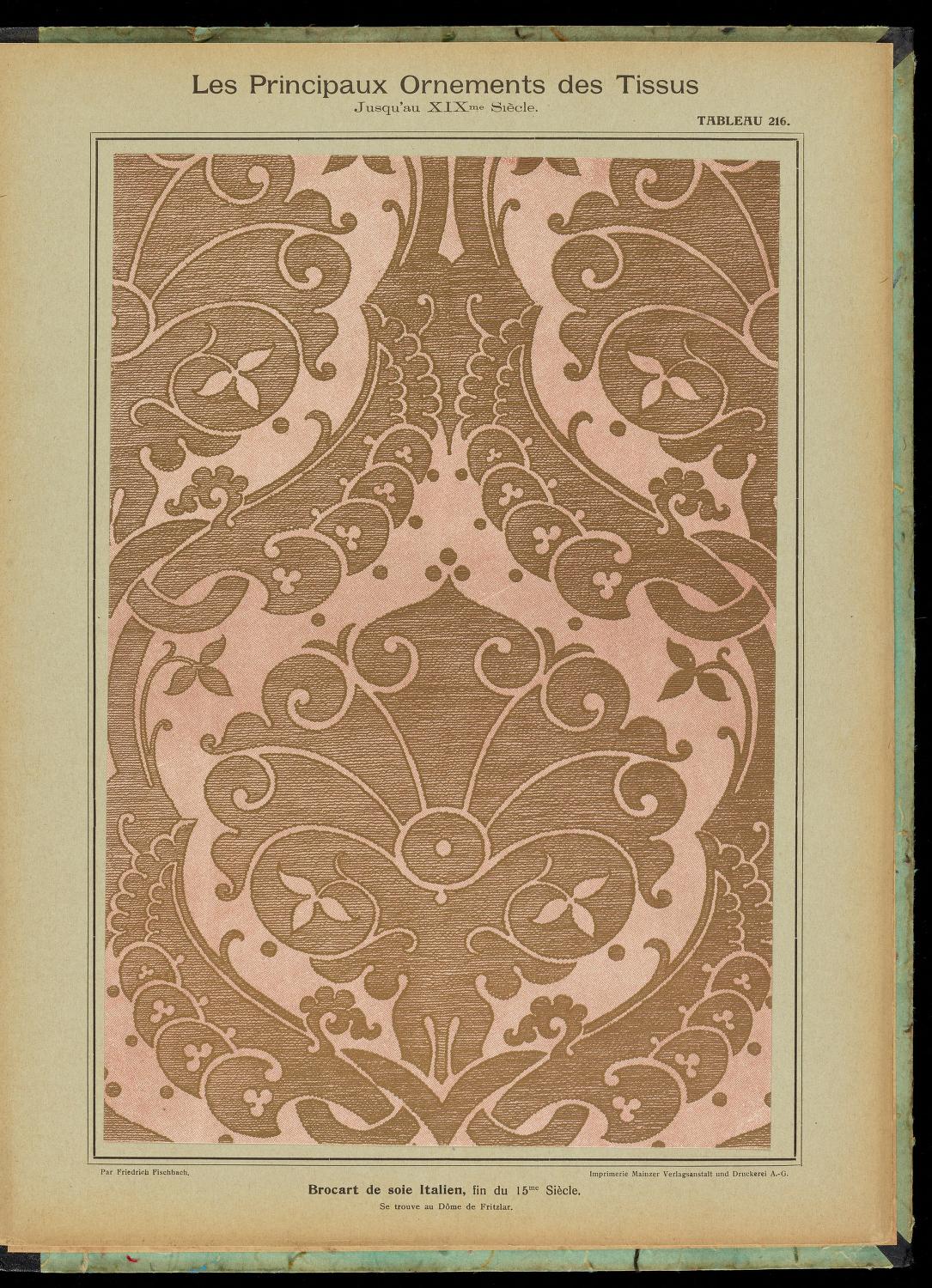
Drawn from Friedrich Fischbach’s legendary historical archive of woven ornament and decorative textile design up to the nineteenth century, this extraordinary volume gathers together some of the most breathtaking examples of medieval textile patterns, Renaissance silk ornament, Gothic fabric motifs, Byzantine weaving traditions, Persian floral brocades, Ottoman decorative textiles, antique damask designs, and historic European ornamental fabric studies ever assembled into a single collection.
The illustrations alone feel almost enchanted.
Velvet-like geometries unfold across the page with hypnotic rhythm. Floral arabesques bloom into endless symmetry. Sacred motifs ripple through woven architecture like fragments of forgotten royal ceremonies preserved in thread.
One begins to understand something startlingly profound:
Human beings have always wrapped themselves in stories.
Sir David Attenborough might observe that textile ornament evolved much like language itself. Patterns migrated across continents through trade, conquest, pilgrimage, marriage, diplomacy, and wandering craftsmen. A Persian floral repeat whispers into Venetian silk. Moorish geometry slips quietly into Spanish weaving. Byzantine gold motifs travel northward into ecclesiastical embroidery.
Designs behaved almost like living organisms.
They adapted.
Merged.
Survived.
And through them, entire civilisations left fingerprints upon history.
For modern creators searching for authentic historical textile patterns, antique fabric ornament inspiration, medieval brocade design references, Gothic wallpaper motifs, Renaissance embroidery studies, luxury fashion pattern archives, or historical decorative textile books, this volume is nothing short of inexhaustible.
Within its pages lie treasures for:
• Fashion designers seeking historical textile inspiration
• Surface pattern artists exploring antique woven motifs
• Fantasy worldbuilders designing royal houses and ancient kingdoms
• Textile historians and decorative arts collectors
• Luxury branding designers inspired by old-world ornament
• Costume designers crafting medieval and Renaissance aesthetics
• Embroiderers, weavers, and artisans studying historical pattern structures
• Tattoo artists searching for ornamental symmetry and sacred geometry
• Interior designers exploring maximalist European decorative traditions
• Lovers of dark academia, Gothic revival, and antique craftsmanship
Yet what makes this work extraordinary is not simply its beauty.
It is its intelligence.
Every woven ornament obeys hidden architectural laws. Unlike painted decoration, textile design must submit to the logic of loom structure, thread tension, repeat systems, and material limitation. Beauty emerges through discipline. Elegance through geometry. Ornament through mathematics married to imagination.
David Ogilvy famously understood that sophistication is not clutter. It is structure made graceful.
This book overflows with precisely that kind of sophistication.
The motifs possess balance without sterility. Grandeur without vulgarity. Richness without excess.
And because these designs were refined slowly across generations rather than manufactured for trends, they feel timeless in the truest sense of the word.
One could easily lose entire evenings wandering through these pages.
A fifteenth-century silk repeat glimmers beside a Gothic ecclesiastical border. Ottoman floral geometry unfurls beside Renaissance woven damask. Heraldic beasts emerge quietly from decorative fields like creatures remembered from old legends.
Jim Henson’s The Storyteller spirit lingers beautifully throughout it all.
One can almost hear the crackling hearth.
Some ancient traveller unfolds a ceremonial cloth before a firelit court and explains that the golden vines represent prosperity, the pomegranate abundance, the lion protection, the interwoven geometry eternity itself.
The old symbols speak softly still.
And modern creators are listening once more.
Today, designers across fashion, interiors, gaming, branding, publishing, luxury packaging, fantasy illustration, and artisan craftsmanship are rediscovering the hypnotic authority of historical ornament because contemporary minimalism has left many souls strangely hungry.
Hungry for texture.
For symbolism.
For richness.
For craftsmanship that feels human.
This volume answers that hunger magnificently.
Whether you are searching for antique textile design inspiration, historical woven pattern references, medieval ornamental fabric studies, Renaissance brocade illustration collections, or timeless decorative motifs for creative work, The Secret Kingdom of Medieval Textile Ornament offers not merely reference material, but creative resurrection.
It restores access to a forgotten visual vocabulary.
A world where cloth carried identity.
Where pattern held meaning.
Where ornament transformed ordinary material into ceremony.
And perhaps most importantly of all, it reminds us that beauty once occupied everyday life with unapologetic confidence.
Curtains were beautiful.
Robes were beautiful.
Banners were beautiful.
Books were beautiful.
Even the hidden lining of a garment might contain astonishing woven splendour simply because the maker believed elegance mattered, even when unseen.
Especially when unseen.
That philosophy alone feels revolutionary today.
This is not merely a collection of historical textile plates.
It is an archive of civilisation dreaming through thread.
A museum of vanished kingdoms woven into ornament.
A masterclass in decorative harmony gathered patiently across centuries.
And now, remarkably, it can belong to your own library.
The looms are humming once more.
The silks unfurl.
The old kingdoms whisper through gold thread and geometry.
Open the book and step carefully into the woven halls of history before the candles burn low.
Share