

Romantic English
The Original English Medieval Foliage Designs (1874 Gothic Ornament Book)
The Original English Medieval Foliage Designs (1874 Gothic Ornament Book)
Couldn't load pickup availability
There are moments, if one is attentive, when history does not feel distant at all… but rather quietly present, waiting to be noticed.
This volume is one such moment.
Drawn from the careful observations of James Kellaway Colling and first published in 1874, Examples of English Medieval Foliage and Coloured Decoration offers something that modern design so often lacks:
Not interpretation.
Not imitation.
But origin.
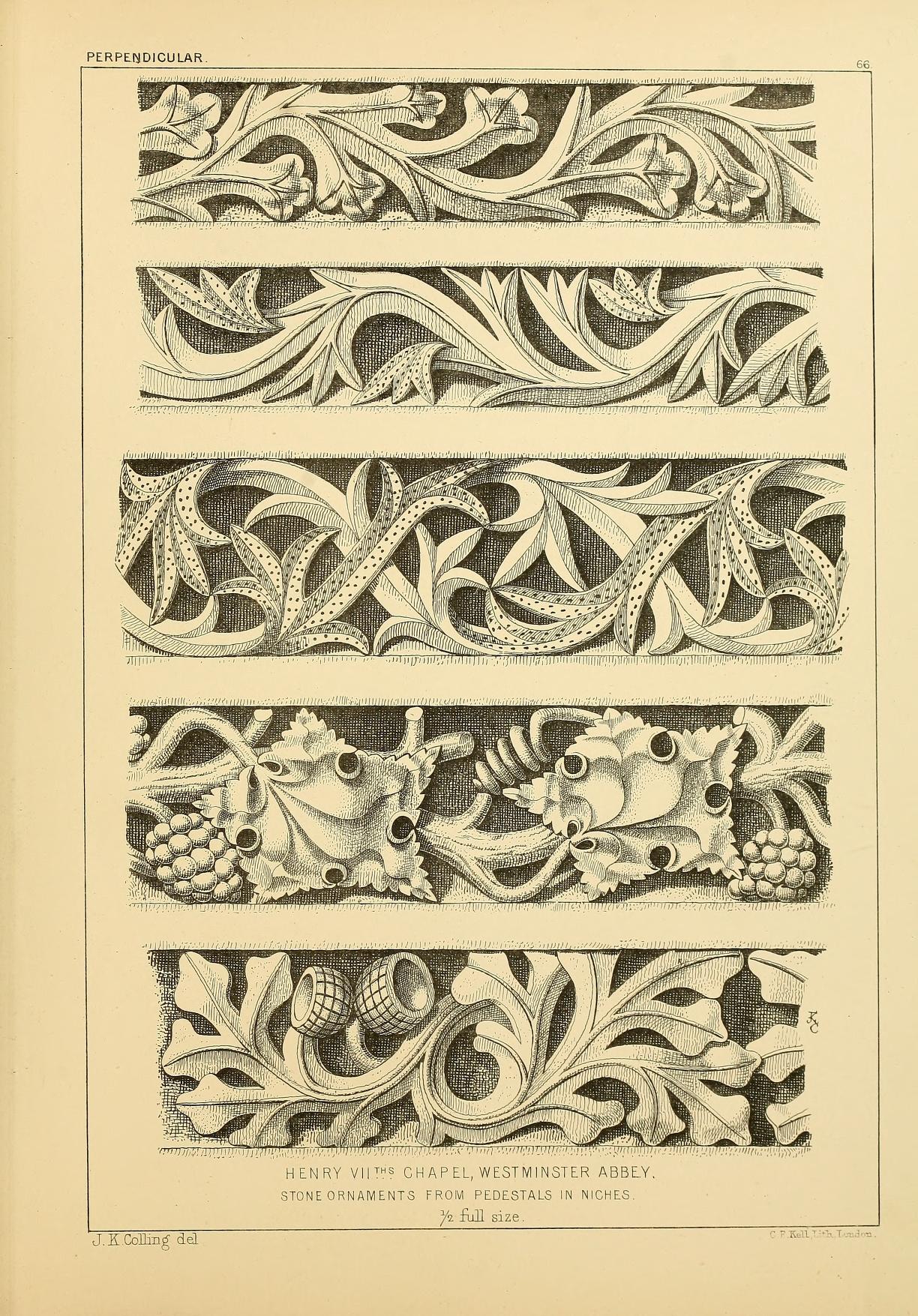
Within its pages, the foliage of English cathedrals and ecclesiastical buildings—dating from the 12th to the 15th century—is recorded with remarkable fidelity. Leaves unfurl not as decoration, but as structure. Tendrils curve with intention. Every carving, every flourish, carries within it the quiet discipline of craftsmen who understood that beauty is not invented… it is discovered.
One begins, perhaps, by admiring the forms.
A vine traced in stone.
An oak leaf rendered with surprising vitality.
A cluster of ornament that appears, at first glance, merely pleasing.
But linger a moment longer, and something rather more profound reveals itself.
These are not random embellishments.
They are part of a language.
A language shaped by nature, refined by hand, and governed by principles that have endured for centuries. Rhythm, proportion, repetition—each present, though never announced. Each working in concert to create what we now recognise, often without quite understanding why, as timeless design.
Romantic English Publishing has approached this work with the utmost respect.
Each plate has been preserved in its original character, allowing the linework, composition, and subtle irregularities of hand-drawn study to remain intact. Nothing has been modernised for convenience. Nothing simplified for ease. What you encounter here is not a reinterpretation, but a faithful revival—clear enough for modern use, yet untouched in spirit.
And it is, if one may say so, immensely useful.
For the designer, it offers a direct connection to authentic English Gothic ornament—forms that may be adapted into textiles, interiors, and compositions with a level of authority that no modern approximation can quite replicate.
For the artist, it provides a study in natural form refined into pattern—how the organic becomes structured without losing its vitality.
For the Romantic English collector, it becomes something quietly invaluable:
A source.
One to which you may return, again and again, each time discovering a detail previously overlooked. A curve that suggests a border. A cluster that inspires a composition. A rhythm that resolves a design you had not yet completed.
It is not a book that instructs loudly.
It simply shows.
And in showing, it teaches.
There is, in that approach, a certain confidence—one that does not demand attention, but earns it.
You may, of course, continue to draw from contemporary sources, as many do. There is no shortage of ornament in the modern world.
But if you wish to create work that feels not merely decorative, but rooted—connected to a lineage that has already stood the test of time—then this volume offers something rather different.
It offers access.
Access to the very forms carved into the fabric of English architecture.
Access to the discipline that shaped them.
Access, ultimately, to a way of seeing that elevates everything it touches.
So consider, if you will, not what this book is…
But what it allows you to become.
A designer who does not borrow, but composes.
An artist who does not imitate, but understands.
A collector whose taste is informed not by trend, but by tradition.
Add the original English medieval foliage designs (1874 gothic ornament book) to your library today.
Study it. Return to it. Draw from it.
And allow your work, quietly and without announcement, to carry with it the unmistakable mark of something enduring.
Available now through Romantic English Publishing
$9.97 – Digital Edition (PDF)
A modest sum, one might say…
For the language of ornament itself.
Share