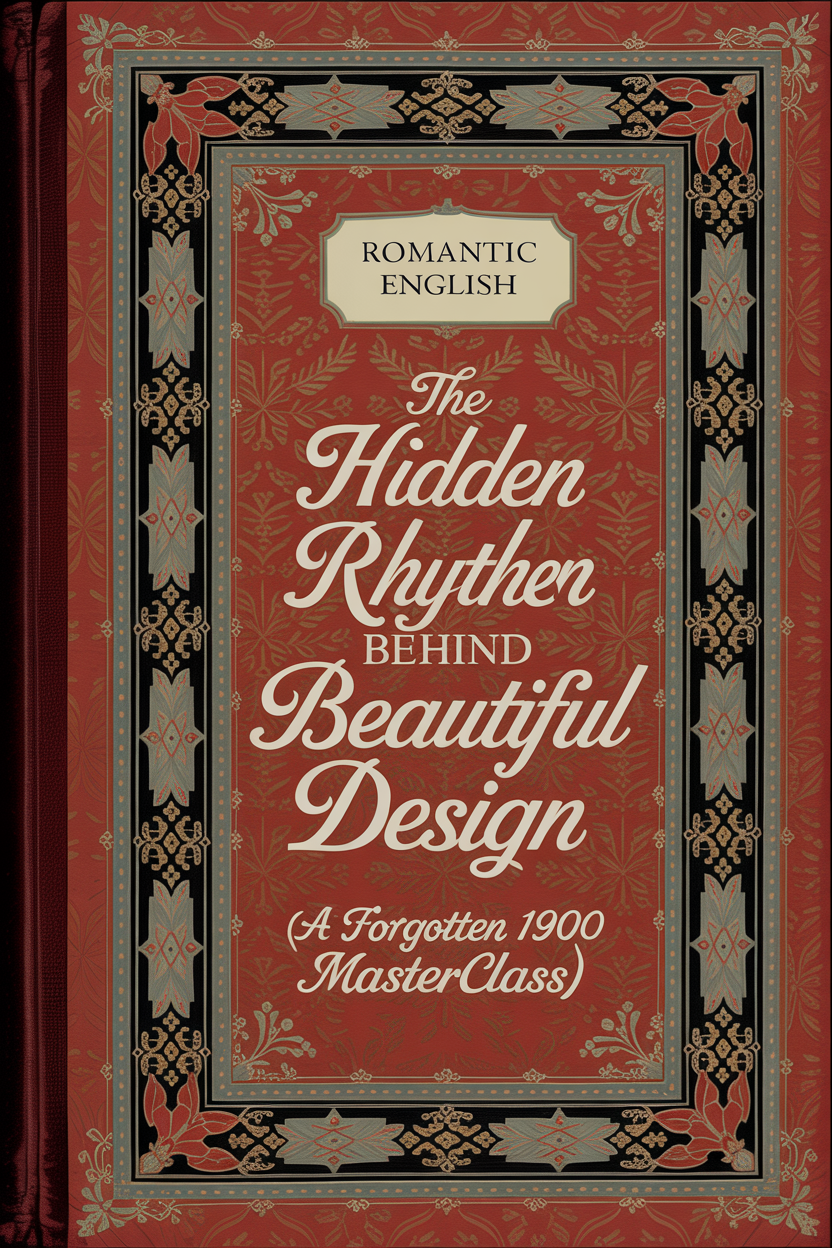


Romantic English
The Hidden Rhythm Behind Beautiful Design (a forgotten 1900 masterclass)
The Hidden Rhythm Behind Beautiful Design (a forgotten 1900 masterclass)
Couldn't load pickup availability
There are books that instruct the hand… and there are those that refine the eye.
This one, quite unmistakably, does both.
At the turn of the 20th century, Maxwell Armfield set down something rather uncommon—not a catalogue of styles, nor a parade of fashionable ornament—but a quiet, disciplined exploration of why certain arrangements please us… and others do not.
He called it rhythmic shape.
A modest title, perhaps.
Yet within its pages lies a principle that governs nearly every work of enduring beauty: that design is not merely assembled—it is orchestrated.
Line follows line not by accident, but by intention.
Forms repeat, but never monotonously.
Space is not empty—it breathes.
And once you begin to see it, you cannot quite unsee it.
A border ceases to be decoration—it becomes cadence.
A pattern becomes movement.
A composition, quite suddenly, begins to feel… inevitable.
Armfield does not overwhelm you with theory. He guides you, gently but firmly, into a way of seeing that is both disciplined and liberating. Through measured examples and carefully constructed exercises, he reveals how rhythm governs the placement of every line, every interval, every flourish.
This is not the language of trends.
It is the language of visual intelligence.
And for those engaged in the creation of interiors, textiles, or any form of ornament—as you are—this knowledge proves quietly transformative.
One begins to design with greater certainty.
With restraint.
With a sense that each element belongs exactly where it rests.
Romantic English Publishing has taken care to preserve this work in its proper spirit. The drawings remain as they were—clear, deliberate, instructive. The tone, measured and thoughtful. Nothing superfluous added, nothing essential removed.
What you receive, therefore, is not an interpretation, but a return.
A return to a moment when design was taught not as expression alone, but as discipline refined into art.
You may approach this book lightly, of course. One always may.
But if you grant it your attention—if you study rather than skim—you will find it begins to influence your work in subtle ways. A better proportion here. A more confident arrangement there.
Until, quite without fanfare, your compositions begin to possess something many pursue and few achieve:
Balance that feels natural.
Movement that feels effortless.
Beauty that feels… correct.
And that, if one may say so, is no small advantage.
So do not merely acquire this volume as one more addition to your collection.
Take it as a tutor.
A quiet one, certainly—but a most exacting one.
Add the art of rhythmic design to your library today.
And allow your work, henceforth, to move with intention rather than chance.
Share