

Romantic English
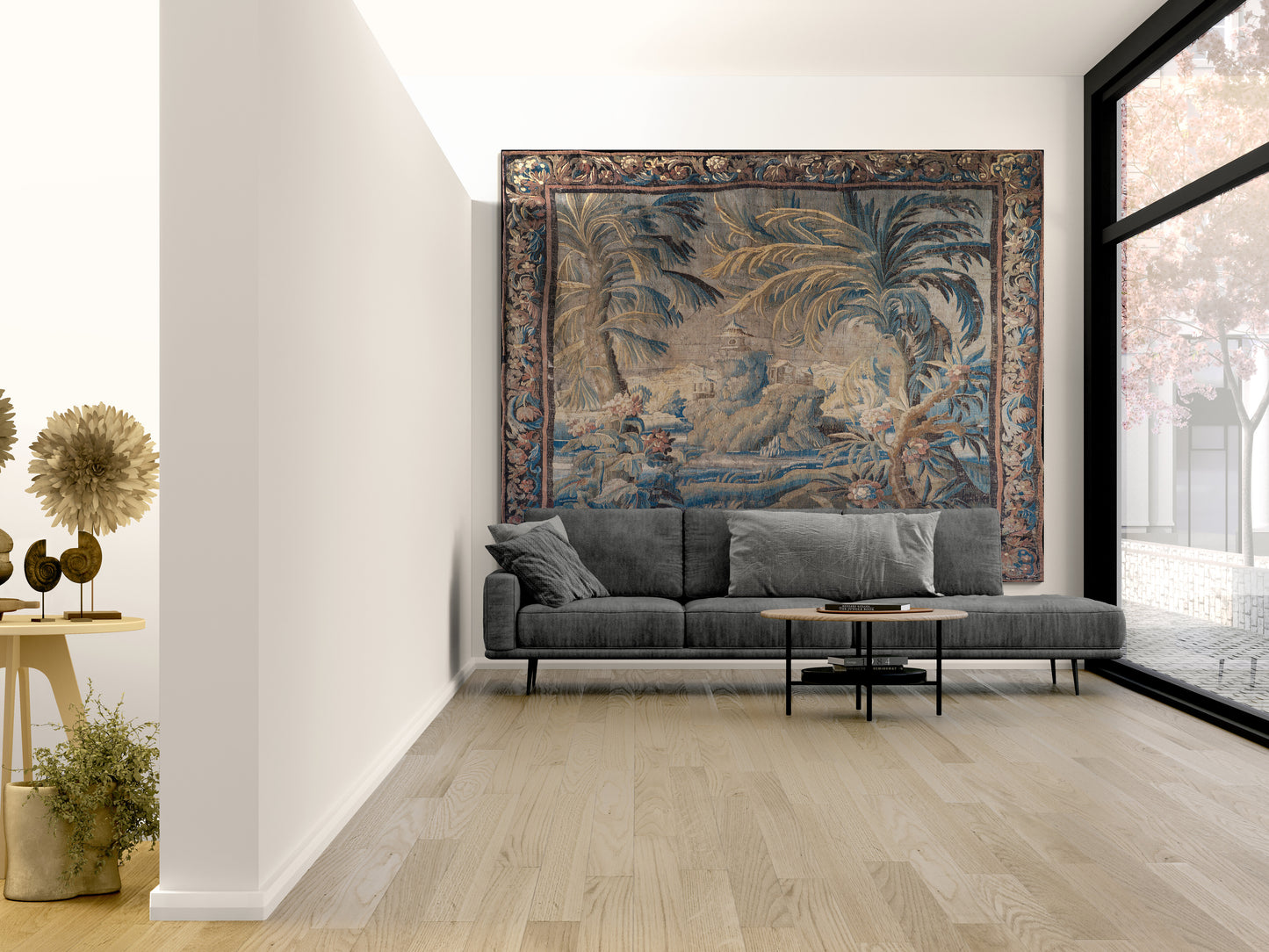
The Enchanted Palm Grove Tapestry – Antique Chinoiserie Tropical Landscape Wall Hanging for Grand European Interiors RE800101
The Enchanted Palm Grove Tapestry – Antique Chinoiserie Tropical Landscape Wall Hanging for Grand European Interiors RE800101
Couldn't load pickup availability
The Enchanted Palm Grove Tapestry — Antique Chinoiserie Tropical Landscape Wall Hanging for Grand European Interiors
There are ordinary wall decorations, and then there are objects that appear to have arrived with a history already attached.
This magnificent Enchanted Palm Grove Tapestry Reproduction belongs firmly to the latter category.
A fantastical landscape unfolds beneath an intricate floral border: great palms bend gracefully across an imagined sky, flowering branches climb through the foreground, water travels between rocky banks, and a distant pavilion rises like a half-remembered palace from an elegant dream.
It is not merely a picture of another place.
It is an invitation to inhabit one.
The composition possesses that marvellous quality found in historic European chinoiserie: part observation, part imagination, and entirely devoted to beauty. Rather than attempting to document a literal landscape, the original artist assembled an enchanting world from distant architecture, tropical foliage, flowing water, ornamental flowers, and theatrical scale.
The result is romantic, mysterious, and wonderfully civilised.
A Room Should Occasionally Surprise You
One can furnish a perfectly respectable room with a sofa, two lamps, a coffee table, and a framed print.
Perfectly respectable.
But unforgettable rooms require something more.
They need a piece that catches the eye from the doorway. Something that encourages a guest to pause, look closer, and ask where on earth it came from.
This tapestry performs that duty with considerable charm.
Its large palm fronds create movement across the composition. The distant architecture draws the eye inward. Muted blues, softened golds, earthy browns, antique rose, and weathered green give the scene the patina of an inherited textile rather than the sharp insistence of newly manufactured décor.
Nothing shouts.
Everything intrigues.
And that is often the difference between a room that has been decorated and one that has been thoughtfully curated.
An Imagined Paradise, Woven in the European Tradition
During the great age of European decorative arts, designers became fascinated with visions of distant lands.
They imagined gardens more luxuriant than any ordinary garden, buildings more mysterious than any familiar palace, and landscapes where geography cheerfully surrendered to fantasy.
These chinoiserie-inspired scenes were never intended as strict records of a particular place. Their purpose was far more delightful: to transport the viewer beyond the boundaries of the everyday.
In this composition, towering palms form a natural canopy around a distant pavilion. Flowering plants rise from the lower border as though the frame itself has begun to grow. Water introduces a cooling rhythm across the landscape, while the deep botanical border encloses the scene like the proscenium of a theatre.
The entire design feels suspended between garden, dream, and stage.
It is precisely this ambiguity that gives it such enduring appeal.
You may see a tropical sanctuary.
Another viewer may imagine a forgotten imperial garden.
Someone else may simply enjoy the extraordinary balance of colour, pattern, and scale.
Great decorative art does not insist upon a single interpretation.
It gives the imagination room to wander.
More Than Wall Art
A tapestry changes a room in ways that framed artwork seldom can.
It introduces softness where architecture feels severe.
It adds scale where a wall feels empty.
It brings texture into rooms dominated by glass, plaster, stone, or flat painted surfaces.
It can visually warm a modern interior, soften the acoustics of a large room, and create an atmosphere that feels established rather than newly assembled.
Most importantly, it gives the wall a presence.
Rather than hanging as a small object upon the architecture, the tapestry becomes part of the architecture itself.
It does not merely occupy space.
It transforms it.
The Perfect Counterpoint to Modern Furniture
One of the loveliest qualities of historic tapestry design is its ability to live comfortably beside modern furnishings.
Place this piece above a clean contemporary sofa and the contrast becomes immediately compelling.
The furniture supplies simplicity.
The tapestry supplies romance.
The architecture provides order.
The landscape introduces imagination.
The result feels layered and intelligent rather than confined to one decorating period.
Indeed, the most interesting homes rarely obey a single style with military discipline. They bring old and new into conversation.
A streamlined sofa beneath an antique-inspired tapestry.
A modern brass lamp beside a carved wooden table.
Minimal architecture warmed by a scene that seems to have travelled through several centuries.
This is how rooms acquire personality.
Not by purchasing an entire matching collection in one afternoon, but by combining objects that appear to have been discovered, inherited, or chosen over time.
Designed to Command a Wall
Historic tapestries were never meant to behave like timid little pictures.
They were created to fill substantial spaces, establish atmosphere, and hold their own against high ceilings, generous furniture, and imposing architecture.
This design is particularly effective when displayed:
Above a large sofa or sectional.
Behind a dining table or sideboard.
In a formal entrance hall.
Over a bed in a romantic primary bedroom.
Within a library, study, or reading room.
Behind a console in a grand hallway.
Inside a boutique hotel, restaurant, lounge, or private club.
As a theatrical backdrop for photography, weddings, or film production.
The design’s broad composition and powerful border allow it to anchor both traditional and contemporary rooms. It can stand alone as the principal work of art or become the centrepiece around which an entire interior is built.
A Palette Made for Collected Interiors
The colouring is one of the tapestry’s greatest strengths.
Deep mineral blues mingle with weathered taupe, aged gold, dusty rose, soft green, charcoal, and muted brown. The tones are rich without becoming garish and subdued without appearing lifeless.
This makes the design remarkably versatile.
Pair it with warm oak, walnut, or mahogany.
Use it above linen, velvet, leather, boucle, or cotton upholstery.
Surround it with antique brass, dark bronze, blackened iron, ceramics, carved wood, or softly aged stone.
Introduce cream and ivory for contrast.
Echo the blue-green foliage through cushions, rugs, books, or decorative glass.
Allow the floral border to inspire accents of faded rose, ochre, and antique gold.
The tapestry already contains an entire interior palette. One need only select a few of its colours and allow them to reappear elsewhere in the room.
For Lovers of English Country House, Chinoiserie and Neoclassical Interiors
This design sits beautifully within a wide range of decorative traditions.
It has enough botanical richness for an English country house.
Enough theatrical fantasy for chinoiserie.
Enough symmetry and ornamental framing for neoclassical interiors.
Enough age and atmosphere for dark academia.
Enough romance for a château-inspired bedroom or salon.
Enough scale and presence for maximalist rooms.
And enough subdued elegance to become the sole historic statement in an otherwise minimal home.
It works particularly well for those who admire:
English manor house interiors.
European country estates.
French château decorating.
Romantic historicism.
Grandmillennial style.
Old-world maximalism.
Quiet luxury.
Collected eclectic interiors.
Botanical wall art.
Museum-inspired décor.
Traditional homes with contemporary furnishings.
It is not limited to one category because true decorative art existed long before modern style labels were invented.
Look From Across the Room
From a distance, the tapestry presents a grand and balanced landscape.
The palms sweep upward.
The central architecture pulls the eye toward the horizon.
The floral border creates an elaborate frame.
The blues and soft earth tones form a calm, cohesive field of colour.
Then step closer.
Leaves divide into individual strokes and woven-looking marks. Flowers emerge from the border. Small architectural details appear in the distance. The surface reveals the irregularities and softened character associated with historic textile art.
This is not a design exhausted by a single glance.
It rewards attention.
A fine tapestry should possess enough detail to be admired for years, not merely enough impact to attract attention for an afternoon.
The Art of Creating Atmosphere
Furniture can make a room functional.
Lighting can make it flattering.
But art determines its emotional character.
This tapestry creates a particular sort of atmosphere: cultivated, romantic, slightly mysterious, and removed from the ordinary pace of modern life.
Imagine it in evening light.
A lamp illuminates the lower border.
The palm leaves recede into shadow.
The blue water becomes deeper.
The distant pavilion appears farther away.
The entire composition begins to feel less like decoration and more like a window opened onto an impossible landscape.
It is the sort of piece that makes a room feel quieter.
Books look more inviting beneath it.
Conversation feels more natural.
Dinner lasts longer.
And even the most practical modern space acquires the gentle suggestion that something marvellous might once have happened there.
A Statement Without Ostentation
Luxury is often misunderstood as brightness, novelty, or excess.
Yet the most convincing rooms rarely need to announce their expense.
They possess confidence.
They contain objects selected because they are beautiful, unusual, and capable of enduring.
This tapestry offers precisely that kind of presence.
It is large, but not loud.
Intricate, but not fussy.
Historic in character, but not confined to a period room.
Its luxury lies in atmosphere rather than spectacle.
It does not beg to be admired.
It simply assumes that it will be.
Created for the Modern Collector
An original antique tapestry of this scale and decorative complexity may be inaccessible to most private collectors. Even when one can be acquired, it often requires specialist conservation, controlled lighting, careful handling, and considerable financial commitment.
A thoughtfully produced reproduction offers another possibility.
It allows the grandeur and decorative intelligence of historic textile art to return to everyday interiors.
Not hidden behind museum glass.
Not reserved solely for palaces or private institutions.
But lived with.
Enjoyed.
Photographed.
Discussed.
And eventually remembered as part of the home itself.
That is the purpose of a fine reproduction: not to pretend to be the original, but to make the beauty of the original tradition available once more.
An Extraordinary Gift
This tapestry also makes a remarkable gift for someone building a meaningful home.
It may be chosen to commemorate:
A wedding.
A new house.
A significant anniversary.
A restoration project.
A milestone birthday.
A new business, hotel, restaurant, or creative studio.
Unlike many decorative gifts, it carries genuine visual importance. It is not something quietly placed upon a shelf and forgotten.
It becomes part of the recipient’s environment.
And when a gift changes the way a room feels, it is remembered long after ordinary presents have disappeared.
Build the Room Around It
Begin with the tapestry.
Then let the rest follow.
A long velvet sofa in moss, tobacco, charcoal, or cream.
A carved console in walnut or oak.
A dark bronze lamp.
A low table bearing art books and a vase of branches.
A faded rug that repeats the tapestry’s blue, rose, and earth tones.
Perhaps one or two chinoiserie ceramics.
Nothing too perfect.
Nothing too coordinated.
The aim is not to create a showroom.
It is to create the feeling that the room has slowly gathered beautiful things across generations.
The tapestry provides the history.
You provide the life around it.
The Romantic English Philosophy
We believe walls deserve more than convenient decoration.
They deserve art with scale, story, and staying power.
Our collection is inspired by the great visual traditions of Europe: tapestry, textile, painting, ornament, botanical design, and the magnificent interiors that brought them together.
We do not believe the past should be copied without imagination.
Nor do we believe modern homes must surrender warmth, romance, and artistry in the pursuit of simplicity.
The finest rooms can contain both.
A clean modern line and an ancient-looking textile.
A practical home and a poetic one.
Comfort and grandeur.
This tapestry embodies that balance beautifully.
Why This Design Endures
Trends depend upon novelty.
Great design depends upon composition.
The Enchanted Palm Grove has already solved the questions that fashionable décor continues to ask.
How does one add drama without visual noise?
Use scale.
How does one add colour without harshness?
Use a time-softened palette.
How does one introduce pattern without clutter?
Frame it within a coherent composition.
How does one make a room memorable?
Give it one object no one else is likely to forget.
This tapestry does all four.
A Final Invitation
Picture the wall as it is now.
Perhaps it is empty.
Perhaps it holds several small pictures that never quite achieved the necessary scale.
Perhaps the room is handsome but lacks a centre of gravity.
Now imagine the palm grove in its place.
The border establishes order.
The trees introduce movement.
The distant pavilion creates mystery.
The blue-green landscape deepens the entire room.
Suddenly the wall no longer feels unfinished.
The furniture seems more intentional.
The space acquires confidence.
That is the curious power of a great tapestry.
It does not merely change the wall upon which it hangs.
It changes everything around it.
Bring Home the Enchanted Palm Grove
Choose this magnificent chinoiserie-inspired tropical landscape tapestry reproduction for the room that deserves more than ordinary decoration.
Bring home the palms, the flowers, the distant pavilion, and the imagined waters of another world.
Create a home that feels collected rather than furnished.
Romantic rather than predictable.
Historic without becoming old-fashioned.
Because a wall may be perfectly useful when left bare.
But dressed in a masterpiece, it becomes unforgettable.
Romantic English
Reviving the art of living beautifully.
Share