
Romantic English
The Golden Passage: A Verdure of Light, Distance, and Civilised Tranquillity RE957624
The Golden Passage: A Verdure of Light, Distance, and Civilised Tranquillity RE957624
Couldn't load pickup availability
There are landscapes one looks at…
and there are landscapes one walks into—quietly, almost without noticing.
This tapestry, with admirable subtlety, extends precisely such an invitation.
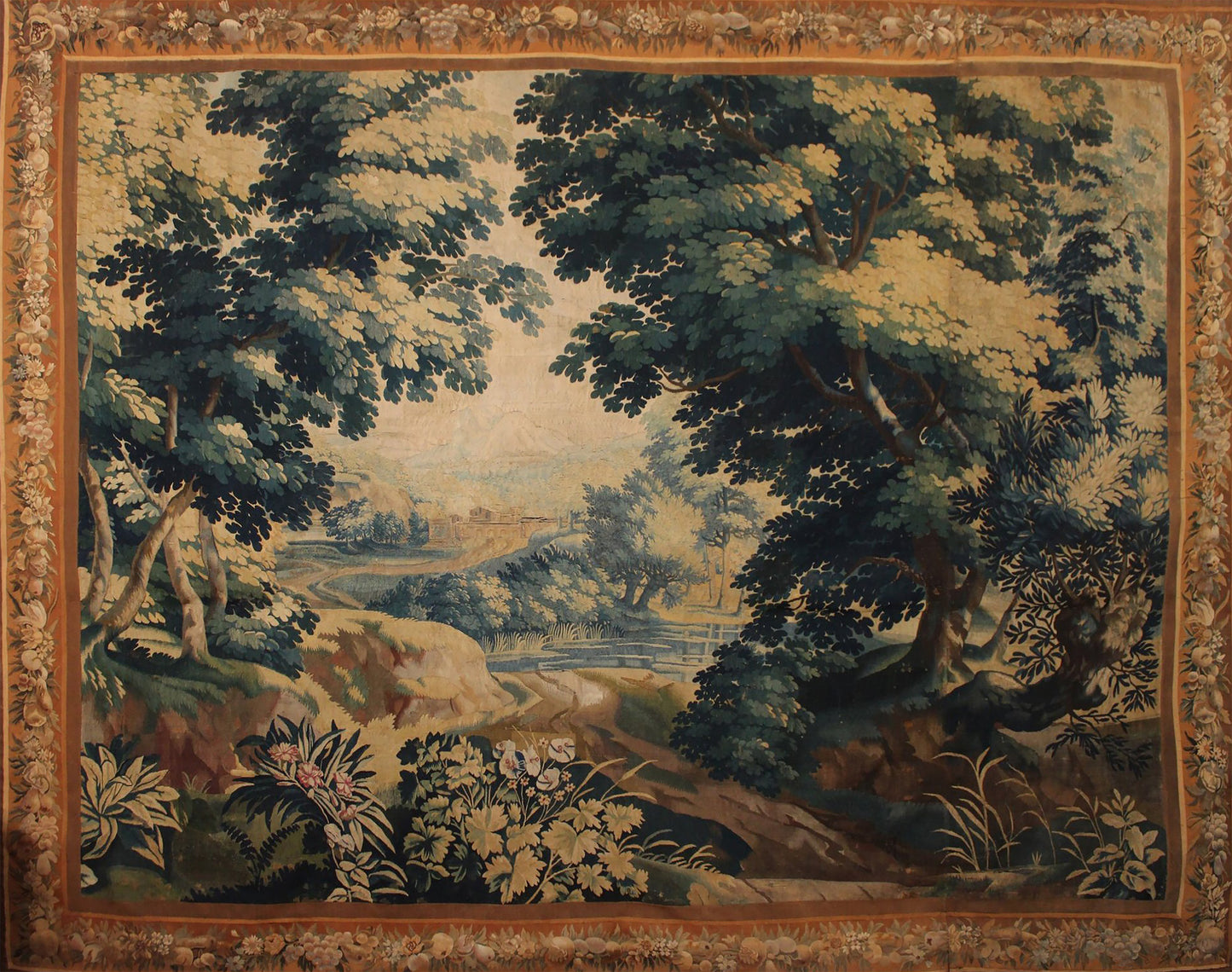
At its heart lies a path—not merely a compositional device, but a narrative in disguise. It winds gently through the foreground, neither hurried nor uncertain, as though it has been there for centuries, patiently awaiting the footfall of those with the good sense to follow it. It curves past clusters of foliage rendered in soft, botanical eloquence—creams, muted greens, and warm earth tones—before disappearing, tantalisingly, into the middle distance.
And what awaits there?
A glimpse—never a proclamation—of civilisation.
A distant estate, nestled among softened hills, emerges through a veil of atmosphere. It is not sharply defined; indeed, it would be quite vulgar if it were. Instead, it hovers delicately on the horizon, suggesting prosperity, order, and that most civilised of luxuries: distance from urgency.
Framing this pastoral journey are two great trees—guardians, one might say—whose canopies arch inward with a kind of deliberate generosity. Their leaves gather in dense, painterly clusters, oscillating between shadowed depth and sunlit gold. The interplay of light here is masterful. It does not blaze; it glows. It filters, softens, persuades.
One begins to feel—not merely see—the dappled coolness beneath these branches.
The palette, rich yet disciplined, leans into warm golds and deep greens, with subtle inflections of blue that prevent the composition from ever becoming complacent. It is a colour story that understands restraint, and therefore achieves richness without excess.
Encasing the entire scene is a border of floral ornament—measured, elegant, and entirely self-assured. It does not compete with the landscape; it completes it, much like a finely crafted frame completes a painting. Together, they form a unified statement of taste—one that speaks, if at all, in a rather refined whisper.
Rendered in dye-injected microwoven cotton-linen canvas, the tapestry achieves a remarkable fidelity to its classical origins. The fibres absorb pigment with a softness that allows every tonal transition—from shadow to light, from foreground to distance—to unfold naturally. Nothing feels imposed. Everything feels… inevitable.
For those seeking a French verdure tapestry, a classical pastoral wall hanging with architectural depth, or a museum-quality reproduction that marries nature with cultivated elegance, this piece offers something quite rare:
A sense of journey.
And in your space?
It does not merely adorn—it guides. The eye follows the path, the mind follows the eye, and suddenly the room itself feels larger, calmer, more considered. It introduces not drama, but continuity—a quiet suggestion that beauty need not be immediate to be profound.
So, if I may conclude with a thought—delivered, as ever, with a certain gentle persuasion:
There are rooms that contain objects…
and there are rooms that contain destinations.
Bring this tapestry into yours—
and allow your walls to lead somewhere worth going.
Share