
Romantic English
The Laurel Grove in Gentle Repose: A Verdant Tapestry of Intimacy, Elegance, and Botanical Wit RE816420
The Laurel Grove in Gentle Repose: A Verdant Tapestry of Intimacy, Elegance, and Botanical Wit RE816420
Couldn't load pickup availability
It is, I think, worth pausing—properly pausing—before one attempts to describe this piece, for it possesses that most elusive of qualities: it does not rush to meet you. It waits. And in waiting, it improves you.
Now then—observe.
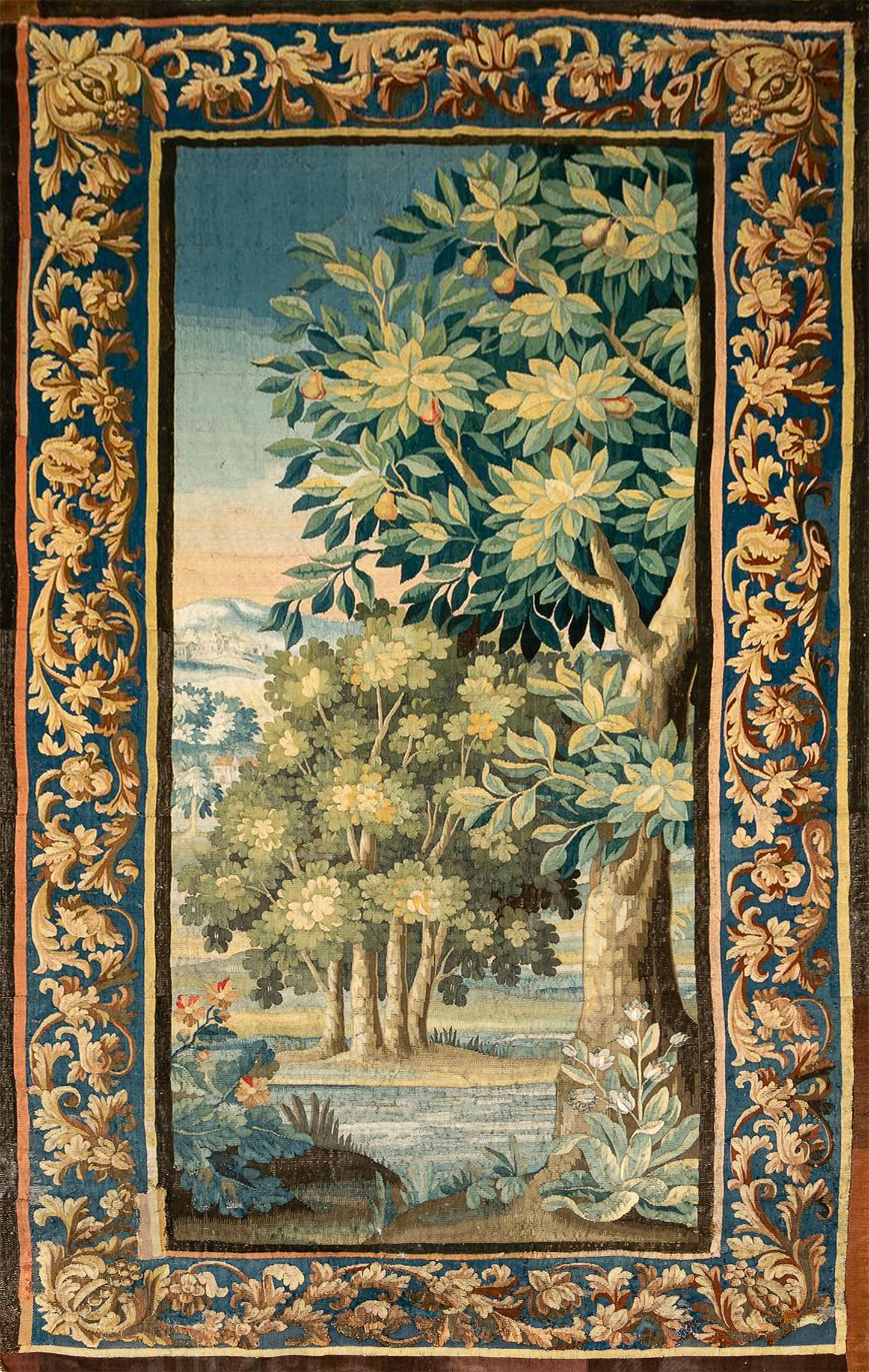
A tree, not merely a tree but a rather self-assured one, occupies the right flank with the composure of an old aristocrat who has long since ceased to explain himself. Its trunk twists ever so slightly, as though it once entertained the notion of movement but thought better of it. Its leaves gather in luminous clusters—soft greens brushed with pale gold—each one catching the light in a manner that suggests not accident, but quiet intention.
And among them—ah yes, there they are—those modest little fruits, nestled like secrets. Not announced, not advertised, but offered. One imagines them being noticed only by those of a sufficiently patient disposition. The sort of viewer who understands that beauty, when properly bred, rarely arrives with a trumpet.
Beneath this arboreal presence, the land relaxes into a small grove—trees gathered as though in conversation, their forms lighter, more conversational, less inclined toward grandeur and more toward companionship. They stand together with a sort of botanical camaraderie, creating a depth that feels less like perspective and more like memory.
And threading its way through this quiet society, a stream—polite, unhurried, impeccably behaved. It glides rather than flows, reflects rather than declares. One suspects it has never, not once, raised its voice.
Beyond, the world softens. Hills dissolve gently into atmosphere, the horizon retreating with a kind of cultivated discretion. It is not the sort of distance that overwhelms; it is the sort that invites. One could, quite comfortably, think here.
Now—if one may indulge—the border.
Good heavens.
It is not merely decorative; it is positively articulate. A deep, confident blue hosts a flourish of golden botanical forms that twist, curl, and unfurl with the sort of assured elegance one associates with individuals who have never had to try too hard. It frames the central scene not as a boundary, but as a declaration: this, it says, is a world worth containing.
And it is.
Now, let us not neglect the matter of substance, for charm without substance is a fleeting acquaintance at best.
This tapestry, rendered on dye-injected microwoven cotton-linen canvas, achieves a fidelity that borders on the conspiratorial. The fibres accept pigment not as a surface gesture, but as a quiet agreement—allowing colour to settle, to breathe, to belong. Every leaf, every tonal shift, every delicate gradation is preserved with a softness that feels less manufactured than inherited.
For those who have wandered—perhaps late into the evening—through phrases such as luxury verdure tapestry wall decor with botanical tree composition, antique European forest tapestry reproduction with ornate border, or classical French verdure wall hanging for elegant interiors, one might gently suggest that the wandering may now cease.
You have, in all likelihood, arrived.
Placed within a room, this piece does something rather extraordinary: it lowers the volume of the world. Not by absence, but by presence. The space becomes more considered, more deliberate. One finds oneself noticing things—light, silence, the placement of a chair—with a newfound clarity.
It does not transform the room so much as educate it.
And so, the question—inevitable, unavoidable, and delivered with the utmost politeness:
Will your walls continue to exist as surfaces—or will they, at long last, acquire character?
Bring this tapestry into your home, and allow it to lend its intelligence, its restraint, and its quiet magnificence to your surroundings.
Secure it now—because pieces of this calibre have a most inconvenient habit of finding their way into the hands of those who recognise them just a fraction sooner.
One does not so much view this tapestry as one is quietly admitted into it—rather like being ushered through a discreet side door into a garden that has, until now, been keeping itself politely to itself.
It is, at first glance, a study in restraint. And yet—how deceptive restraint can be when handled by a master.
A single tree commands the right-hand side of the composition, its trunk rising with a certain unhurried authority, as though it has been here rather longer than anyone cares to remember—and sees no particular reason to leave. Its branches extend outward, bearing clusters of leaves rendered in tones so delicately modulated—sage, pale gold, softened green—that one begins to suspect the artist understood not merely foliage, but temperament.
And nestled among those leaves—quietly, almost conspiratorially—hang small fruits. Not ostentatious, not demanding admiration, but present nonetheless. The sort of detail one notices only after a moment’s acquaintance, and then cannot unsee. A reward for attention. A nod to those who linger.
Below, the land softens into a gentle clearing, where a grove of smaller trees gathers in companionable proximity. Their forms are lighter, more delicate—like a chorus echoing the confident solo of the great tree above. Together, they create a layered depth that feels less constructed than discovered.
A stream, ever the civilising influence, glides through the foreground with admirable discretion. It does not interrupt; it connects. Its surface reflects just enough light to guide the eye without ever becoming the subject itself. One might say it behaves precisely as water ought.
Beyond, the landscape recedes into a distant horizon—hills softened by atmosphere, sky rendered in a gradient so subtle it feels less painted than remembered. It is not a dramatic distance, but a contemplative one. The sort that invites thought rather than demands it.
And then—framing all this quiet sophistication—a border of extraordinary character.
Rich, scrolling, and unapologetically ornamental, it surrounds the central scene like a well-composed sentence framed by impeccable punctuation. The deep blue ground, enlivened with golden botanical motifs, provides a contrast that is both striking and entirely controlled. It is, if one may be forgiven the expression, a flourish executed with impeccable manners.
Now, to the matter of craft—because a piece such as this deserves not only admiration, but understanding.
Rendered on dye-injected microwoven cotton-linen canvas, this tapestry achieves a remarkable fidelity to its historic lineage. The fibres receive pigment with a softness that allows every nuance to settle naturally—the layered transitions of leaf and light, the gentle interplay of tone, the quiet richness of the border. This is museum-quality verdure tapestry reproduction wall art, designed not merely to replicate, but to honour.
For those who have found themselves in pursuit of luxury verdure tapestry wall decor with botanical tree scene, antique European pastoral tapestry reproduction with ornate blue border, or classical French verdure wall hanging for refined interiors, one might gently suggest that the search has reached a rather satisfying conclusion.
Placed within a room, this piece does something quite remarkable: it introduces intimacy. Not the grand, sweeping drama of vast landscapes—but the cultivated quiet of a space that has been considered, composed, and allowed to breathe. It invites the eye to slow. To notice. To remain.
And there is, in that invitation, a certain luxury.
So, one must ask—politely, but with purpose:
Will your walls continue to declare—or might they begin, at last, to whisper?
Bring this tapestry into your home, and allow it to lend its poise, its subtle wit, and its botanical elegance to your surroundings.
Secure it now—because pieces of such quiet distinction have an uncanny tendency to be appreciated elsewhere by those who recognise them first.
Share