
Romantic English
The Peacock’s Dominion: A Verdant Symphony in Blue and Gold RE399810
The Peacock’s Dominion: A Verdant Symphony in Blue and Gold RE399810
Couldn't load pickup availability
There are tapestries that decorate a wall…
and there are tapestries that compose a world.
This, I daresay, belongs emphatically to the latter.
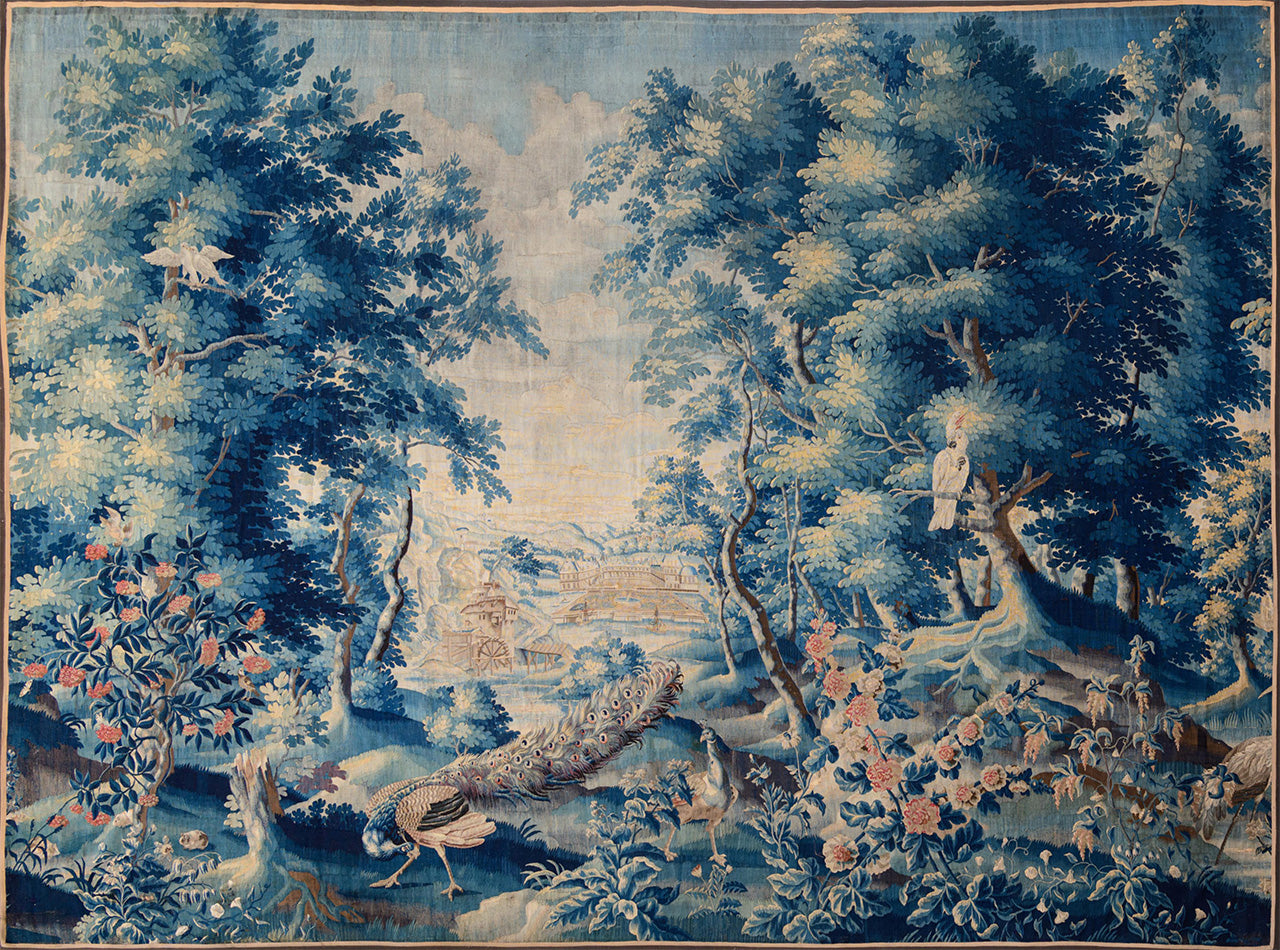
One is immediately drawn—almost ceremoniously—into a landscape where colour has been disciplined into poetry. The blues alone deserve a paragraph of their own: not merely blue, but an orchestration of sapphire, powder, slate, and the faintest whisper of twilight. They gather in the foliage like a well-rehearsed choir, each leaf contributing to a harmony that feels both lush and restrained.
And then—enter the peacock.
Not with vulgar flamboyance, as lesser interpretations might have it, but with a kind of aristocratic composure. Its tail, a cascade of patterned brilliance, trails behind like a royal train, each eye a tiny universe of detail. It does not perform. It exists, which is far more impressive.
Nearby, its quieter companion—perhaps a peahen—moves with understated grace, while above, perched among the branches, birds observe the scene with the mild curiosity of seasoned witnesses. One senses that nothing here is accidental; every creature, every bloom, every branch has been placed with the deliberation of a composer arranging notes.
The landscape opens gently toward the distance, where architecture emerges—bridges, structures, the faint geometry of civilisation—softened by atmosphere, as though remembered rather than seen. It is that most enchanting of artistic devices: the promise of a world beyond the immediate, inviting the eye to wander and the mind to follow.
And what a garden it is.
Floral clusters bloom with quiet confidence—pinks, creams, and subtle greens—never shouting, always conversing. The ground undulates softly, guiding the gaze in a manner so natural one scarcely notices the choreography.
This is verdure not as mere decoration, but as philosophy.
Rendered in dye-injected microwoven cotton-linen canvas, the tapestry achieves a fidelity that feels almost conspiratorial—as though it has quietly borrowed the soul of its historical antecedents. The fibres hold the pigment with remarkable dignity, allowing transitions of tone and depth that lend the entire piece a lived-in authenticity.
For those searching—whether knowingly or not—for a French verdure tapestry with peacock, a classical European pastoral wall hanging, or a museum-quality textile reproduction, this is not simply a candidate. It is, quite plainly, a statement.
And in your space?
It will not merely hang.
It will preside.
Rooms acquire a different temperament in its presence. Conversations seem to lower themselves to a more considered register. Light behaves more thoughtfully. Even time, if you will permit the indulgence, appears to move with a touch more grace.
So allow me, in closing, a thought of gentle persuasion:
There are objects one buys…
and there are pieces one invites into one’s life.
This is very much the latter.
Bring it home—and let your walls learn the art of quiet magnificence.
Share