
Romantic English
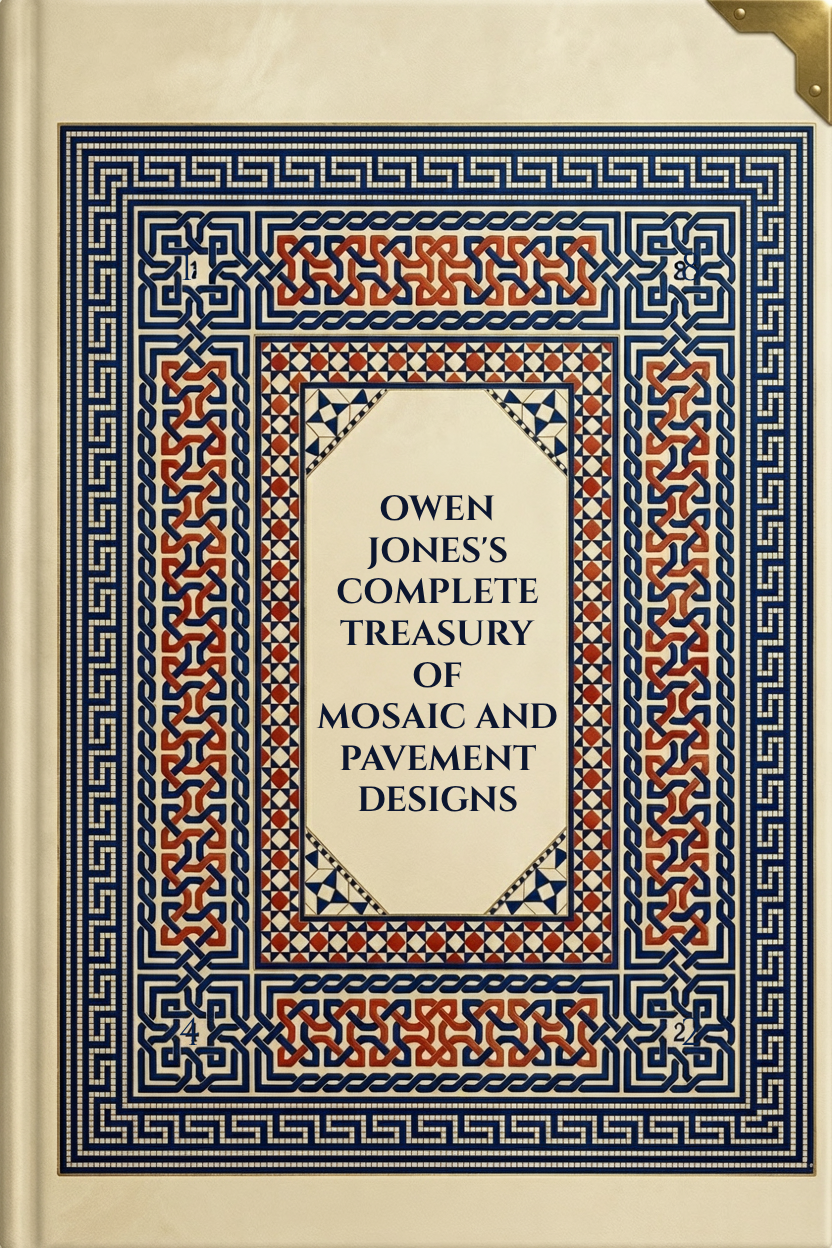
Owen Jones’s Complete Treasury of Mosaic and Tessellated Pavement Designs
Owen Jones’s Complete Treasury of Mosaic and Tessellated Pavement Designs
Couldn't load pickup availability
The Floor Beneath Your Feet Was Once Considered a Work of Art
There was a time when a floor was not merely something upon which one placed a chair.
It was an entrance.
A proclamation.
A carefully composed field of colour, geometry and ornament that told every visitor—before a single word had been spoken—that beauty had been considered here.
In grand halls, churches, villas, libraries and public buildings, mosaic and tessellated pavements transformed practical surfaces into enduring works of design. Stars unfolded from circles. Borders interlocked with astonishing precision. Repeating forms created rhythm, order and grandeur beneath the feet.
And few designers understood the power of ornament more completely than Owen Jones.
First published in 1842, Designs for Mosaic and Tessellated Pavements preserves a remarkable collection of historic geometric floor patterns, ornamental borders and tile compositions from one of the nineteenth century’s most influential authorities on decorative design.
Now presented as a Romantic English Archive Edition, this rare visual treasury is available as a convenient ebook for artists, designers, architects, decorators, makers and collectors who believe that even the humblest surface deserves rather more imagination than a stretch of polite beige.
A Lost Design Language, Recovered
Modern flooring is often sold by the square foot.
Historic flooring was designed by the square inch.
Every line mattered.
Every colour had a role.
Every border guided the eye.
Every repeated motif contributed to the harmony of the whole.
Owen Jones understood that ornament was not a collection of decorative distractions. It was a visual language governed by proportion, balance, repetition and structure.
The designs in this volume reveal how simple geometric forms can be combined into compositions of extraordinary richness.
Squares become lattices.
Circles become rosettes.
Triangles create movement.
Stars emerge from precise intersections.
Borders frame the central design like architecture around a room.
The result is not random decoration. It is disciplined beauty.
And that is precisely what makes this volume so useful today.
Not Merely a Collection of Old Floors
One might reasonably ask: what possible use can an 1842 portfolio of pavement designs have in the modern world?
Rather a great deal, as it happens.
The patterns contained in this book can inspire far more than flooring.
They can be adapted for:
- Mosaic and tile installations
- Rugs and woven textiles
- Wallpaper and surface patterns
- Fabric and upholstery design
- Decorative ceilings
- Painted floors and stencilled panels
- Book covers and endpapers
- Packaging and luxury branding
- Architectural borders
- Furniture inlay
- Ceramics and tableware
- Posters and graphic compositions
- Digital pattern libraries
- Historical film and theatre sets
- Interior-design mood boards
A well-constructed geometric pattern does not belong to one material or one century.
It may begin as a pavement and reappear as a textile.
It may begin as a tile border and become a book jacket.
It may be enlarged for a wall, reduced for a label or repeated across an entire room.
Jones gives you the principles.
Your imagination decides where they travel next.
For Interior Designers Who Want Rooms with Memory
A beautiful room does not need to resemble a museum.
But it ought to feel as though someone had an idea.
The designs in this collection offer a deep source of inspiration for interiors influenced by:
- Classical architecture
- Victorian design
- Gothic Revival
- Neoclassical decoration
- Mediterranean villas
- Historic English houses
- Grand hotels and restaurants
- Libraries and studies
- Conservatories and garden rooms
- Entry halls and statement foyers
A geometric floor can establish the entire character of a space.
It can create formality without heaviness.
Colour without clutter.
Ornament without chaos.
Even when the original pattern is not reproduced exactly, the book teaches valuable lessons about scale, rhythm and visual hierarchy.
Where should the eye rest?
How broad should the border be?
How does a central field relate to the room around it?
How can contrasting shapes create movement without creating disorder?
These are not merely historical questions. They are the daily concerns of good interior design.
For Artists and Pattern Designers
The blank page is a splendid symbol of creative possibility.
It is also, on certain mornings, a rather smug white rectangle.
Jones provides an alternative.
Open the ebook and begin with a structure already rich in possibility.
Study a border.
Trace a repeating unit.
Examine how positive and negative space interact.
Observe how a small geometric cell expands into a broad decorative field.
A single page may suggest an entire collection of:
- Textile repeats
- Wrapping papers
- Art prints
- Decorative panels
- Digital backgrounds
- Wallpaper designs
- Rug patterns
- Ceramic borders
- Journal covers
- Stationery suites
The designs are especially useful because they are built upon clear geometry. They can be analysed, redrawn, recoloured and adapted with remarkable flexibility.
This is not inspiration that vanishes when examined closely.
It becomes more useful the longer one looks.
For Architects and Historic Preservationists
Ornament has always had a structural role.
A border marks transition.
A central motif establishes focus.
A repeating pavement pattern organises movement through a space.
Jones’s designs demonstrate how decoration can support architecture rather than merely being placed upon it afterward.
For architects, preservationists and students of historical design, this ebook offers visual reference for:
- Entrance halls
- Ecclesiastical interiors
- Civic buildings
- Historic residences
- Courtyards
- Galleries
- Corridors
- Conservatories
- Decorative thresholds
- Restoration concepts
The portfolio also provides insight into the nineteenth-century study and revival of ornamental design—a period when architects and designers looked carefully at historic models, not to retreat into the past, but to recover principles that could serve the present.
A sensible ambition, and one perhaps worth attempting again.
For Tile Makers, Mosaic Artists and Craftspeople
The craftsperson sees what others overlook.
Where most people see a pattern, the maker sees:
The joint.
The repeat.
The cut.
The meeting point.
The question of how one shape sits beside another without causing either visual or practical rebellion.
This volume is therefore especially valuable for mosaic artists, tile designers, ceramicists, stoneworkers and decorative painters.
Its patterns can serve as:
- Direct historical reference
- Starting points for custom commissions
- Studies in tessellation
- Border and corner inspiration
- Colour-placement guides
- Exercises in symmetry and repetition
- Sources for hand-painted tile collections
- Foundations for contemporary reinterpretation
Some compositions are restrained.
Others are gloriously intricate.
All demonstrate the astonishing variety that can emerge from disciplined geometric thinking.
For Graphic Designers and Brand Builders
Historic pattern is a powerful branding tool when used intelligently.
A geometric border can suggest heritage.
A tessellated motif can communicate craftsmanship.
A mosaic-inspired composition can create an immediate sense of place, culture or permanence.
This collection offers inspiration for:
- Heritage-brand identities
- Boutique hotels
- Restaurants and wine bars
- Luxury packaging
- Artisan products
- Publishing houses
- Cultural institutions
- Architectural firms
- Interior-design studios
- Historic venues
- Wedding stationery
- Premium labels and seals
The goal is not to make every modern business resemble a railway station from 1873.
The goal is to borrow the confidence, order and visual richness of historic ornament and apply it with contemporary judgment.
Jones gives the modern designer a vocabulary far more memorable than another logo composed of two thin intersecting lines.
A Masterclass in Geometry Without the Lecture
Geometry can sound severe.
It brings to mind rulers, examinations and the possibility that someone will shortly ask you to calculate an angle.
Jones reveals the more civilised side of the subject.
Here, geometry becomes decorative.
Mathematics becomes rhythm.
Repetition becomes music for the eye.
The designs show how visual complexity often grows from very simple ingredients:
- A square rotated
- A circle divided
- A star repeated
- A border mirrored
- A line interlaced
- A colour alternated
Studying these plates can improve one’s understanding of:
- Symmetry
- Tessellation
- Proportion
- Visual rhythm
- Repetition
- Contrast
- Modular design
- Border construction
- Pattern continuity
- Spatial balance
No lengthy theoretical argument is required.
The eye understands.
A Digital Edition Made for Creative Use
A rare antique portfolio is a marvellous object.
It is also an inconvenient companion to a cup of coffee, a studio table and an enthusiastic house cat.
The ebook edition allows the designs to be enjoyed and studied with far greater ease.
Keep it on your desktop while designing.
Open it on a tablet beside your sketchbook.
Zoom into intricate intersections.
Compare borders.
Return to favourite motifs whenever a project requires more structure, history or distinction.
A digital archive offers the freedom to explore without placing a fragile nineteenth-century volume in mortal danger every time one wishes to inspect a corner ornament.
This edition belongs in the working library, not merely behind glass.
Why Owen Jones Still Matters
Owen Jones believed that ornament should be studied seriously.
He recognised that great decorative art was not produced by simply adding more things.
It was produced by arranging forms according to clear principles.
That lesson remains valuable.
Today, anyone can fill a surface.
Very few can organise one beautifully.
Jones’s work teaches restraint within richness.
Order within complexity.
Variety within repetition.
His designs demonstrate that decoration can be abundant without being confused, intricate without being chaotic and historical without being lifeless.
These are not quaint Victorian curiosities.
They are enduring lessons in design intelligence.
A Reference Book You Will Use Again and Again
Some ebooks are read once and forgotten in the darker reaches of a digital library.
This is not such a book.
It is a volume to browse before beginning a project.
To consult when a composition feels incomplete.
To open when you need a border, a repeat, a colour arrangement or simply a reminder that human beings once devoted considerable talent to making floors magnificent.
Every return reveals something new:
A surprising corner treatment.
An elegant alternation of colour.
A clever use of symmetry.
A pattern that could become a rug, a textile, a wall panel or the foundation of an entire collection.
This is the great advantage of a visual sourcebook.
Its value grows through use.
For Those Who Believe Beauty Should Be Built In
There is a regrettable habit in modern design of treating beauty as an optional upgrade.
Something applied at the end, provided the budget has not already been consumed by ventilation systems and conference-room chairs.
Historic designers thought differently.
Beauty was part of the structure.
It began at the threshold.
It continued across the walls.
And it was quite prepared to follow you onto the floor.
Owen Jones’s Complete Treasury of Mosaic and Tessellated Pavement Designs restores that way of thinking.
It invites us to imagine interiors in which every surface participates.
Rooms with rhythm.
Floors with identity.
Borders that frame rather than merely finish.
Patterns that make an ordinary passage feel ceremonial.
That is not extravagance.
It is design doing its job properly.
Bring This Rare 1842 Design Portfolio Into Your Library
You could spend countless hours searching for historic tile patterns, mosaic borders and geometric floor references across scattered archives.
Or you could place one carefully assembled treasury directly at your fingertips.
Inside this ebook waits a world of:
- Historic geometric composition
- Mosaic design inspiration
- Tessellated pavement patterns
- Classical borders
- Ornamental tile motifs
- Architectural decoration
- Colour and pattern ideas
- Enduring lessons in symmetry and proportion
Whether you are planning a room, designing a textile, restoring a building, developing a product collection or simply collecting beautiful books, this volume offers a wealth of practical and visual inspiration.
Open the Portfolio. Study the Patterns. Transform the Surface.
A floor need not be forgotten.
A border need not be ordinary.
A geometric pattern need not feel cold.
In the hands of Owen Jones, each becomes an opportunity for beauty, structure and imagination.
Add Owen Jones’s Complete Treasury of Mosaic and Tessellated Pavement Designs to your digital library today.
Explore the rare 1842 portfolio.
Save the patterns that speak to you.
Use them to inspire interiors, textiles, tiles, publications and decorative projects of your own.
Click now to claim your Romantic English Archive Edition—and discover how much splendour can begin beneath your feet.
Share