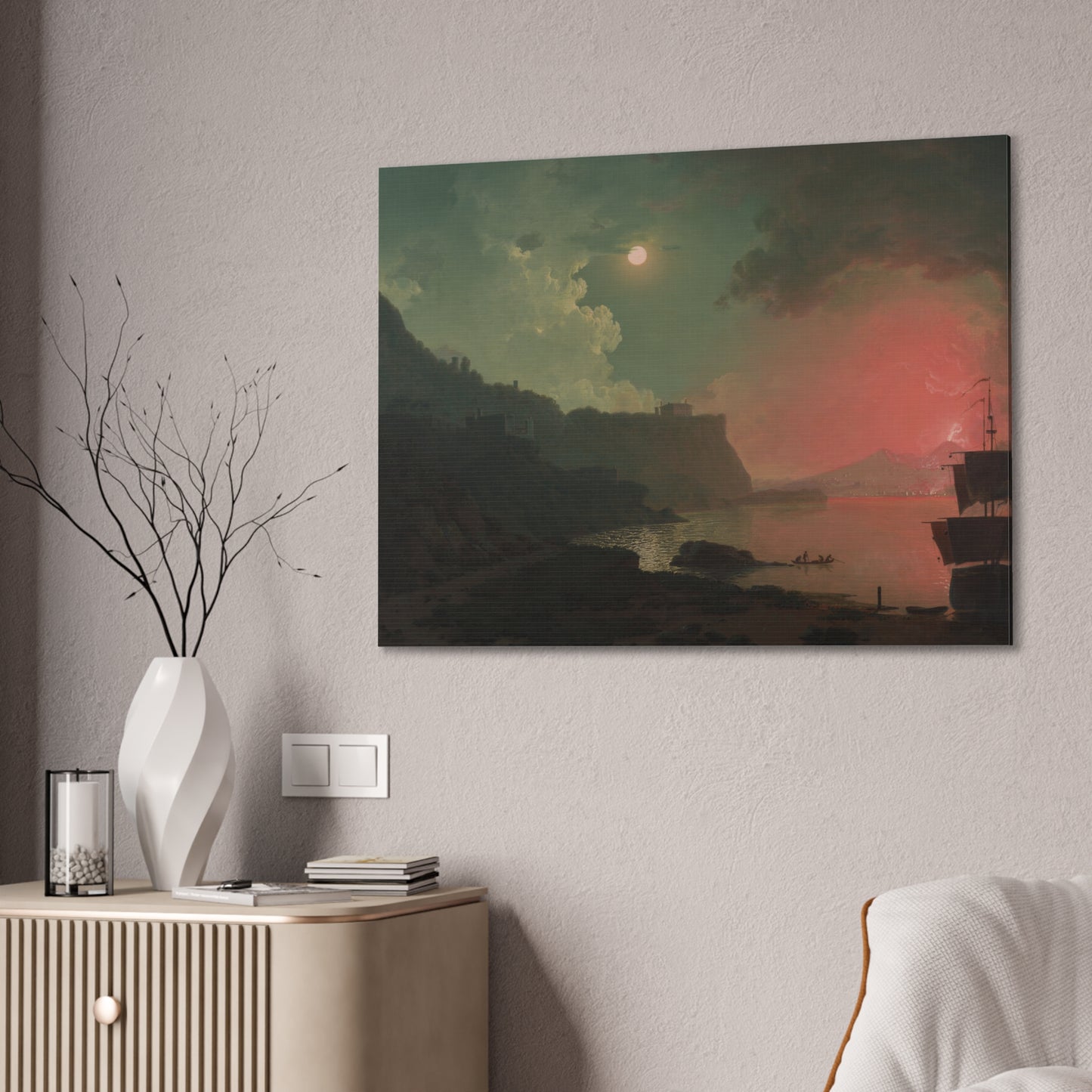
There are landscapes — and then there are spectacles of nature rendered with the gravity of theatre.
In Vesuvius from Posillipo, painted around 1788, Wright gives us not merely a volcano, but a confrontation between civilisation and sublimity. Mount Vesuvius rises in luminous menace against the Neapolitan sky, its fiery eruption puncturing the darkness like a celestial disturbance. The air glows with molten light. The sea reflects the drama. Humanity, dwarfed along the shore, becomes witness rather than master.
Wright was not simply recording geology. He was painting Enlightenment curiosity — the scientific fascination with natural forces — fused with the Romantic awe that would soon define an era. Fire becomes illumination. Smoke becomes atmosphere. The volcano becomes philosophy.
The vantage point from Posillipo — a coastal ridge overlooking the Bay of Naples — allows the viewer both proximity and safety. We are close enough to feel the tremor, distant enough to contemplate it. It is precisely this balance that makes the painting enduringly powerful.
Why It Matters
-
It is one of the great visual meditations on the Sublime.
-
It captures 18th-century Europe’s fascination with natural science and spectacle.
-
It represents Wright at his most dramatic — master of light, shadow, and controlled chaos.
For a modern interior, Vesuvius from Posillipo is not merely historical art. It is atmosphere. It brings movement, luminosity, and a subtle tension to a room. Particularly striking above a mantel, in a study, or within a gallery wall of classical works.
It speaks to the intellectually curious — those who understand that beauty need not always be tranquil. Sometimes, it burns.