

Romantic English
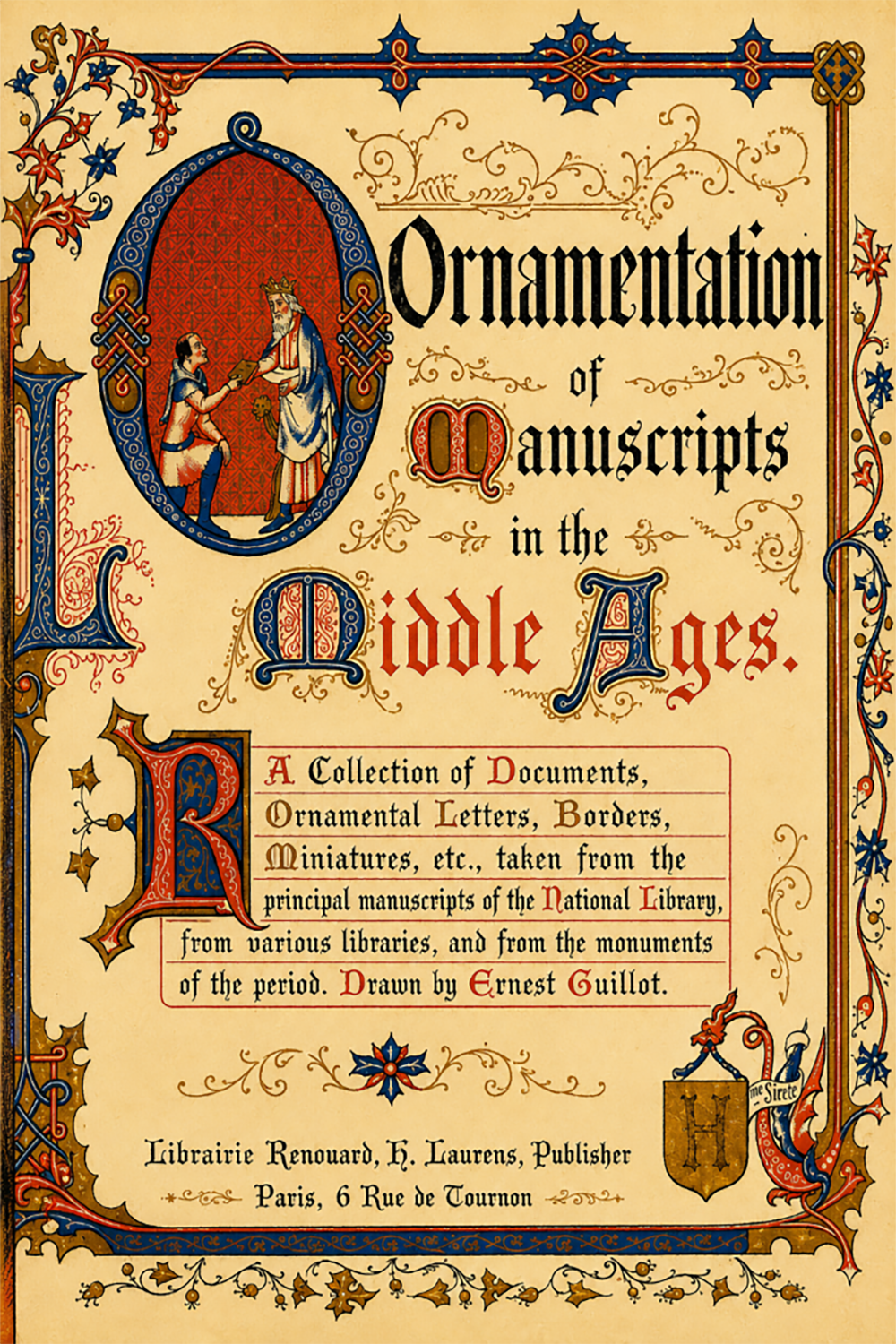
The Medieval Designer’s Lost Pattern Book: Gothic Initials, Illuminated Borders, Dragons, Ivy and Decorative Lettering from Ernest Guillot’s Rare Manuscript Archive
The Medieval Designer’s Lost Pattern Book: Gothic Initials, Illuminated Borders, Dragons, Ivy and Decorative Lettering from Ernest Guillot’s Rare Manuscript Archive
Couldn't load pickup availability
There are books one reads.
There are books one consults.
And then there are books so richly decorated, so gloriously unnecessary in all the correct ways, that one feels compelled to keep them nearby simply because civilisation appears slightly better behaved in their presence.
The Medieval Designer’s Lost Pattern Book belongs emphatically to the latter category.
Originally assembled and drawn by the French decorative artist Ernest Guillot, this extraordinary visual archive preserves a treasury of medieval manuscript ornament: illuminated initials, curling ivy borders, architectural frames, heraldic devices, fantastical creatures, elegant letterforms, dragons, foliage, sacred vessels and curious marginal beings that seem to have wandered in from the more imaginative corners of the Middle Ages.
Now, this rare historical sourcebook has been prepared as a convenient ebook edition—allowing artists, designers, decorators, typographers, historians and incurably romantic collectors to explore its remarkable pages wherever inspiration happens to strike.
No reading room.
No white gloves.
No stern librarian peering over a pair of spectacles.
Simply open the book and enter.
A Lost World of Ornament, Recovered Page by Page
Modern design is often praised for being clean.
Sometimes, one suspects it has been cleaned rather too thoroughly.
The medieval artist had no such anxiety.
A letter was not merely a letter. It could become a tower, a flowering vine, a serpent, a saint, a dragon or an entire miniature theatre populated by kings, angels and peculiar animals of uncertain temperament.
A border did not politely remain at the edge of the page. It grew, curled, climbed and occasionally sprouted wings.
This ebook reveals that world in vivid detail.
Within its pages, you will discover:
- Elaborate illuminated initials derived from historic manuscripts
- Gothic letterforms filled with vines, leaves, birds and fantastic beasts
- Medieval page borders and decorative framing systems
- Stylised foliage, ivy trails and foliate ornament
- Dragons, grotesques and marginal creatures
- Heraldic devices and architectural details
- Sacred objects and ceremonial motifs
- Historical colour combinations in red, blue, green, gold and parchment tones
- Decorative compositions suitable for both study and creative inspiration
Each plate offers more than historical interest. It presents a complete visual vocabulary—one that can still inspire contemporary work in textiles, interiors, publishing, branding, illustration and decorative art.
Not Merely a Book—A Working Design Library
Suppose you are creating a book cover and require an initial that does not look as though it was selected from a dropdown menu.
Suppose you are designing a tapestry, wallpaper, poster, invitation, textile, journal, logo or decorative border and would prefer to begin with something possessing several centuries of character.
Suppose you simply adore illuminated manuscripts and wish to inspect their details without travelling to Paris, applying for an archive appointment or explaining to airport security why your luggage contains six magnifying glasses.
This ebook is for you.
Its pages can be studied for:
Lettering inspiration
Examine the structure of medieval initials, decorative capitals and ornamental alphabets.
Border design
Discover how line, foliage, architecture and fantasy creatures were combined to frame a page.
Colour reference
Observe historic palettes built around deep blue, vermilion, green, ochre, gold and warm parchment.
Pattern development
Use the plates as inspiration for repeating motifs, textile layouts and surface designs.
Creative research
Build mood boards for medieval, Gothic Revival, Arts and Crafts, romantic or historic interiors.
Pure visual enjoyment
Because not every beautiful object must justify itself with a quarterly performance report.
For Artists, Designers and Makers
The finest reference books do not tell you precisely what to make.
They enlarge your sense of what can be made.
A single page may suggest the border of a tapestry.
Another may inspire an entire alphabet.
A curling dragon may become a textile motif. A narrow ivy band may become wallpaper trim. A painted initial may become the centrepiece of a poster, journal cover, wedding invitation or luxury package.
This is precisely why historic design archives remain so valuable.
They return us to a time before decorative imagination was reduced to a handful of fashionable templates.
They remind us that beauty may be intricate.
That colour may be bold.
That a border may behave dramatically.
And that even the humble letter A can enter a room wearing ceremonial robes.
For Writers, Publishers and Book Lovers
Anyone interested in book design will find these pages especially compelling.
Before the printed page became uniform, manuscripts were individual works of architecture. Text, image, border and ornament were conceived together. The page was not merely a surface carrying information; it was a complete visual environment.
Guillot’s drawings preserve that remarkable approach.
For publishers and independent authors, the ebook offers inspiration for:
- Historical fiction covers
- Fantasy book design
- Decorative chapter openings
- Illustrated journals
- Poetry collections
- Medieval and Renaissance publications
- Luxury edition concepts
- Gothic and romantic visual branding
Even a modest digital publication can acquire enormous distinction when informed by authentic historical design.
For Interior Designers and Romantic Decorators
The ideas contained in these plates are not confined to books.
They can be translated into:
- Wall art
- Tapestry compositions
- Decorative panels
- Rugs and textiles
- Upholstery patterns
- Wallpaper borders
- Stained-glass concepts
- Painted furniture
- Architectural ornament
- Gallery-wall collections
The medieval manuscript page was, in miniature, an interior.
It contained borders, colour, structure, narrative, symbolism and atmosphere. Enlarged and reinterpreted, these same elements can give a room the sense of history and drama so often missing from modern decoration.
For those building Gothic Revival, medieval, Arts and Crafts, old-world or neoclassical environments, this archive is a splendid beginning.
Why Choose the Ebook Edition?
An antique copy may be rare, fragile and expensive.
This digital edition is designed to be used.
Open it on your computer while designing.
Keep it on your tablet beside the drawing board.
Zoom into the curves of an illuminated letter.
Study the relationship between a dragon’s tail and the border it has apparently decided to invade.
Return to the book whenever a project requires more imagination, more history or simply more splendour.
There is no need to protect it from sunlight, humidity, curious children, ambitious cats or cups of tea placed with regrettable confidence.
It is a practical archive for the modern creative mind.
A Rare Source of Authentic Inspiration
There is no shortage of medieval-looking imagery online.
Authentic medieval design reference is another matter.
This collection matters because it was assembled from historic manuscripts, libraries and monuments. Guillot was not inventing a vague fantasy of the Middle Ages. He was documenting and interpreting real decorative sources.
That distinction can be seen in the details:
The strange proportions.
The elegant irregularities.
The disciplined colour.
The curious creatures.
The way foliage turns into architecture and architecture into lettering.
These are qualities that modern imitation often smooths away. Here, they remain gloriously intact.
For the Collector Who Prefers Substance to Fashion
Trends arrive breathlessly and depart without saying goodbye.
Historical beauty is rather less nervous.
The designs in this collection have survived because they possess rhythm, character and visual authority. They do not require an algorithm to declare them interesting.
Whether your taste leans toward medievalism, Gothic Revival, Arts and Crafts, fantasy illustration, romantic interiors or antique typography, this ebook offers a source of inspiration that will not become obsolete next season.
It is not simply fashionable.
It is useful.
It is beautiful.
And it has already passed the most demanding test of all: time.
Bring the Medieval Archive Into Your Own Creative World
You could spend hours searching for scattered examples of illuminated initials, manuscript borders and Gothic ornament.
Or you could open one carefully assembled volume and find an entire visual language waiting inside.
The Medieval Designer’s Lost Pattern Book places that language at your fingertips.
Study it.
Save your favourite pages.
Build mood boards from it.
Use it to inspire your next textile, poster, room, book, pattern or decorative collection.
Or simply enjoy the delightful knowledge that while modern typography struggles to select between “regular” and “semibold,” a thirteenth-century letterform may contain three dragons, a bishop and an oak tree.
Open the archive. Discover the details. Create something worthy of them.
Add the ebook to your digital library today and begin exploring Ernest Guillot’s extraordinary world of Gothic initials, illuminated borders and medieval ornament.
Click now to enter the archive—and let the Middle Ages furnish your imagination.
Share